
Reading Time: 5 minutes
Energy-Efficient HVAC Houston: Lower Bills and Better Comfort for Your Home
- SEER2 and EER2 ratings determine real-world efficiency, with Houston homes benefiting most from systems exceeding 15.0 SEER2
- Leaky ductwork can waste 20-30% of conditioned air, undermining even the most efficient equipment
- Proper system sizing through Manual J calculations prevents energy waste and humidity problems
- Variable-speed technology delivers superior humidity control crucial for Houston’s climate
- Federal tax credits through 2032 can significantly offset high-efficiency HVAC upgrade costs
+
- Unlock Savings and Comfort with Energy-Efficient HVAC in Houston
- Understanding Energy-Efficient HVAC: What Makes a System Truly Efficient
- Why SEER2 Replaced SEER and What Houston Homeowners Need to Know
- Beyond the Rating: Holistic Factors That Determine Real-World Efficiency
- How Leaky Ductwork Undermines Even the Most Efficient HVAC System
- Why Humidity Control Is Essential for Comfort in Houston
- What Mistakes Cause New HVAC Systems to Underperform
- Quick Actions That Lower Energy Bills Before Replacing Equipment
- Financial Incentives That Help Offset Energy-Efficient HVAC Costs
- How Clean Air Houston Pro Supports Energy Efficiency Goals
- Frequently Asked Questions
Unlock Savings and Comfort with Energy-Efficient HVAC in Houston
Houston homeowners face a relentless battle against heat and humidity. Summer temperatures regularly exceed 95 degrees Fahrenheit while dew points hover in the oppressive 70-76 degree range. These conditions force air conditioning systems to work overtime, driving electricity bills higher and leaving many homes feeling uncomfortable despite constant cooling. Residents across the Greater Houston area are actively seeking solutions that deliver lower energy bills without sacrificing comfort.
Energy-efficient HVAC systems offer a compelling answer to this challenge. Modern high-efficiency units consume significantly less electricity per unit of cooling delivered, which translates directly into reduced monthly expenses. Beyond cost savings, these systems provide improved humidity control, more consistent temperatures throughout the home, and a smaller environmental footprint. Understanding what makes a system truly efficient and how to maximize that efficiency in Houston’s demanding climate empowers homeowners to make informed decisions that pay dividends for years to come.
Understanding Energy-Efficient HVAC: What Makes a System Truly Efficient
Efficiency in HVAC equipment is measured through standardized metrics that allow meaningful comparisons between systems. The primary ratings homeowners encounter when shopping for air conditioning are SEER2, EER2, and HSPF2. Each metric captures different aspects of performance, and understanding them helps clarify what efficient actually means in practical terms.
SEER2 stands for Seasonal Energy Efficiency Ratio 2. This rating measures cooling output divided by energy input over an entire cooling season, accounting for varying outdoor temperatures. Higher SEER2 numbers indicate greater efficiency. EER2, or Energy Efficiency Ratio 2, measures performance at a single high-temperature condition, specifically 95 degrees Fahrenheit, making it particularly relevant for Houston’s peak summer heat. HSPF2 applies to heat pumps and measures heating efficiency.
Why SEER2 Replaced SEER and What Houston Homeowners Need to Know
The Department of Energy updated testing procedures in January 2023, introducing SEER2 and EER2 to replace the previous SEER and EER metrics. The new testing protocol applies higher static pressure during evaluation, simulating real-world conditions more accurately. This change means SEER2 numbers appear slightly lower than equivalent SEER ratings. A system previously rated at 16 SEER might now carry a 15.2 SEER2 rating, even though actual performance remains unchanged.
For Houston specifically, Texas falls within the Southeast region for DOE minimum efficiency standards. Current regulations require split-system air conditioners under 45,000 BTU per hour to meet at least 15.0 SEER2 and 11.7 EER2. Systems between 45,000 and 65,000 BTU per hour must achieve 14.5 SEER2 and 11.7 EER2. Understanding these baselines helps homeowners recognize when a system exceeds minimum standards and offers genuine efficiency advantages.
How Does EER2 Affect Performance During Houston’s Hottest Days
While SEER2 reflects seasonal average performance, EER2 captures how well a system performs when temperatures peak. Houston experiences extended periods where outdoor temperatures exceed 95 degrees Fahrenheit, and this is precisely when air conditioning demand and electricity rates reach their highest levels. A system with strong EER2 performance maintains cooling capacity and efficiency during these critical hours.
“They did a fantastic job. The Houston allergens and poor air quality in my home were problematic. Scheduling was easy, and the team was professional and thorough.”
Beyond the Rating: Holistic Factors That Determine Real-World Efficiency
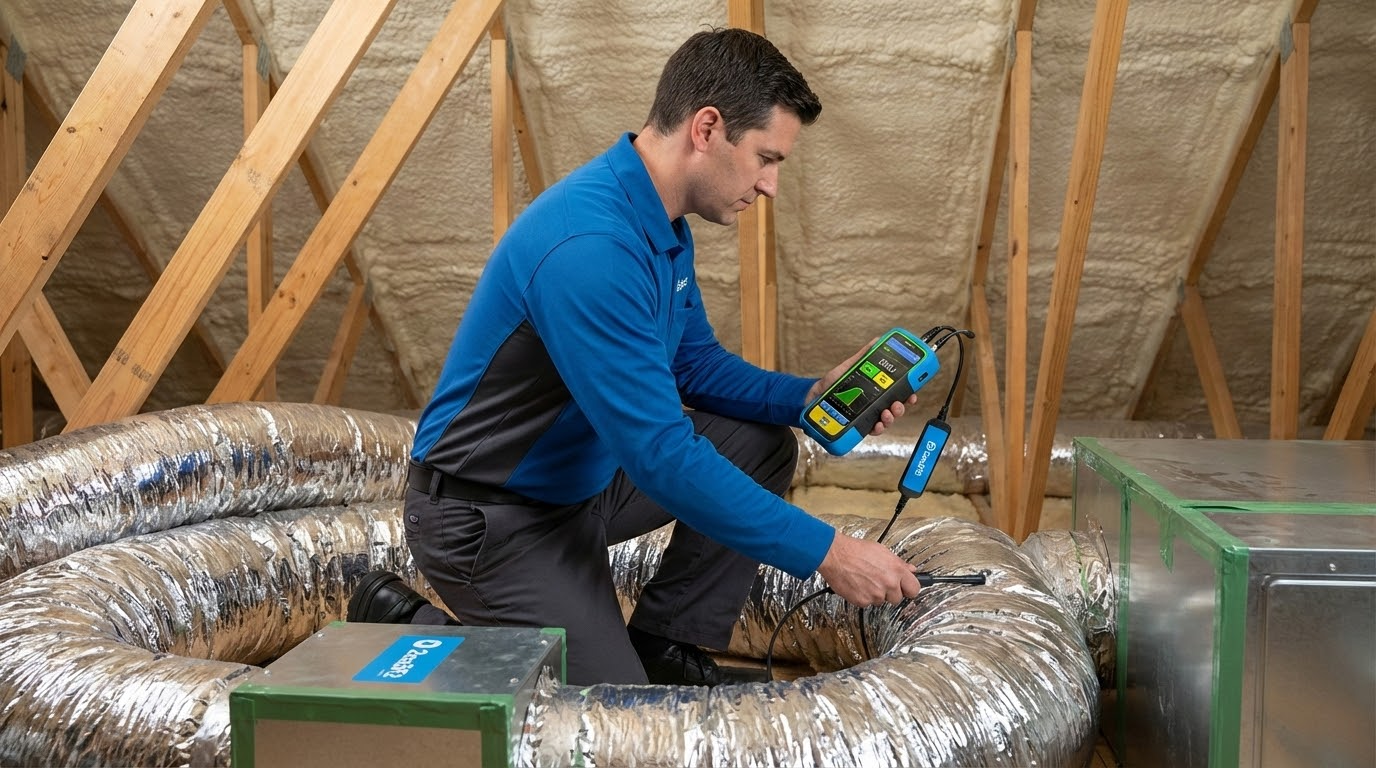
Equipment ratings tell only part of the efficiency story. A system rated at the highest SEER2 available can still underperform if installation and supporting systems are inadequate. Three critical factors determine whether a home actually realizes the efficiency promised on paper: proper sizing, ductwork integrity, and humidity management.
Why Proper Sizing Matters More Than Most Homeowners Realize
An incorrectly sized system, whether too large or too small, wastes energy and compromises comfort. Oversized equipment cools the air quickly but shuts off before adequately removing humidity, leading to clammy indoor conditions despite low thermostat settings. This short-cycling also increases wear on components and raises electricity consumption through frequent startup surges. Undersized equipment runs continuously without ever reaching target temperatures, consuming energy without delivering comfort.
The industry standard for determining correct system size is Manual J, an ANSI-recognized residential load calculation methodology. This calculation considers home square footage, insulation levels, window area and orientation, local climate data, and occupancy patterns. Any contractor proposing equipment without performing this calculation is essentially guessing, and that guess can undermine even the most efficient equipment.
Our certified technicians can evaluate your current system and identify opportunities to reduce energy costs while improving comfort.
Or call us: (832) 737-8500
How Leaky Ductwork Undermines Even the Most Efficient HVAC System
Ductwork hidden in attics, crawlspaces, and wall cavities often contains gaps, loose connections, and deteriorated seals that allow conditioned air to escape. Approximately 20 to 30 percent of air moving through a typical duct system can be lost to leaks, holes, and poorly connected ducts. In a Houston attic reaching 140 degrees Fahrenheit during summer, any air leaking into that space represents pure waste. The system must work harder and longer to compensate.
Sealing and insulating ducts is one of the most effective ways to improve HVAC efficiency and home comfort. Proper sealing prevents conditioned air from escaping while also blocking hot attic air from infiltrating the system. Insulating ducts that pass through unconditioned spaces reduces thermal loss. Homeowners who upgrade equipment without addressing duct issues often find their new system delivers disappointing results. The investment in high efficiency literally leaks away.
| Duct Problem | Impact on Efficiency | Typical Symptoms |
|---|---|---|
| Leaky connections at registers | Conditioned air lost to wall cavities | Weak airflow at certain vents |
| Disconnected duct runs | Major air loss to attic or crawlspace | Rooms that never cool properly |
| Uninsulated ducts in attic | Heat gain from 140+ degree attic air | Supply air feels warmer than expected |
| Crushed or kinked flex duct | Restricted airflow increases system strain | High static pressure, noisy operation |
Why Humidity Control Is Essential for Comfort and Efficiency in Houston
Houston’s humidity presents a challenge that goes beyond simple temperature management. When dew points reach the 70s, as they frequently do from April through October, the air holds significant moisture that must be removed to achieve actual comfort. Residents know the feeling of stepping into a home that feels cool but still unpleasant.
Air conditioning systems remove humidity as a byproduct of cooling. Moisture condenses on the evaporator coil and drains away. However, systems that are oversized, short-cycling, or poorly configured may not run long enough to achieve adequate dehumidification. Indoor relative humidity between 30 and 60 percent is recommended for optimal comfort and health. Efficient systems designed with Houston’s climate in mind often include features that enhance dehumidification, such as variable-speed operation that allows longer run times at lower output.
Does Variable-Speed Technology Actually Deliver Better Results
Traditional single-stage air conditioners operate in a binary fashion: fully on or completely off. Two-stage systems add an intermediate setting, typically around 65 to 70 percent capacity. Variable-speed systems adjust output continuously across a wide range, matching capacity precisely to current conditions. This graduated approach offers several advantages particularly relevant to Houston homes.
Variable-speed systems run longer at lower output rather than cycling on and off frequently. Extended run times improve dehumidification since the coil stays cold and continues condensing moisture from the air. Temperature swings decrease because the system maintains conditions rather than allowing the home to heat up before responding. Energy consumption drops because the system avoids the high startup current required each time a compressor engages. Noise levels fall since the system typically operates well below maximum capacity.
“Stacy’s team was awesome fast and professional! They explained everything to me before they did anything. Very fair pricing. I will definitely use them again.”
What Mistakes Cause New HVAC Systems to Underperform
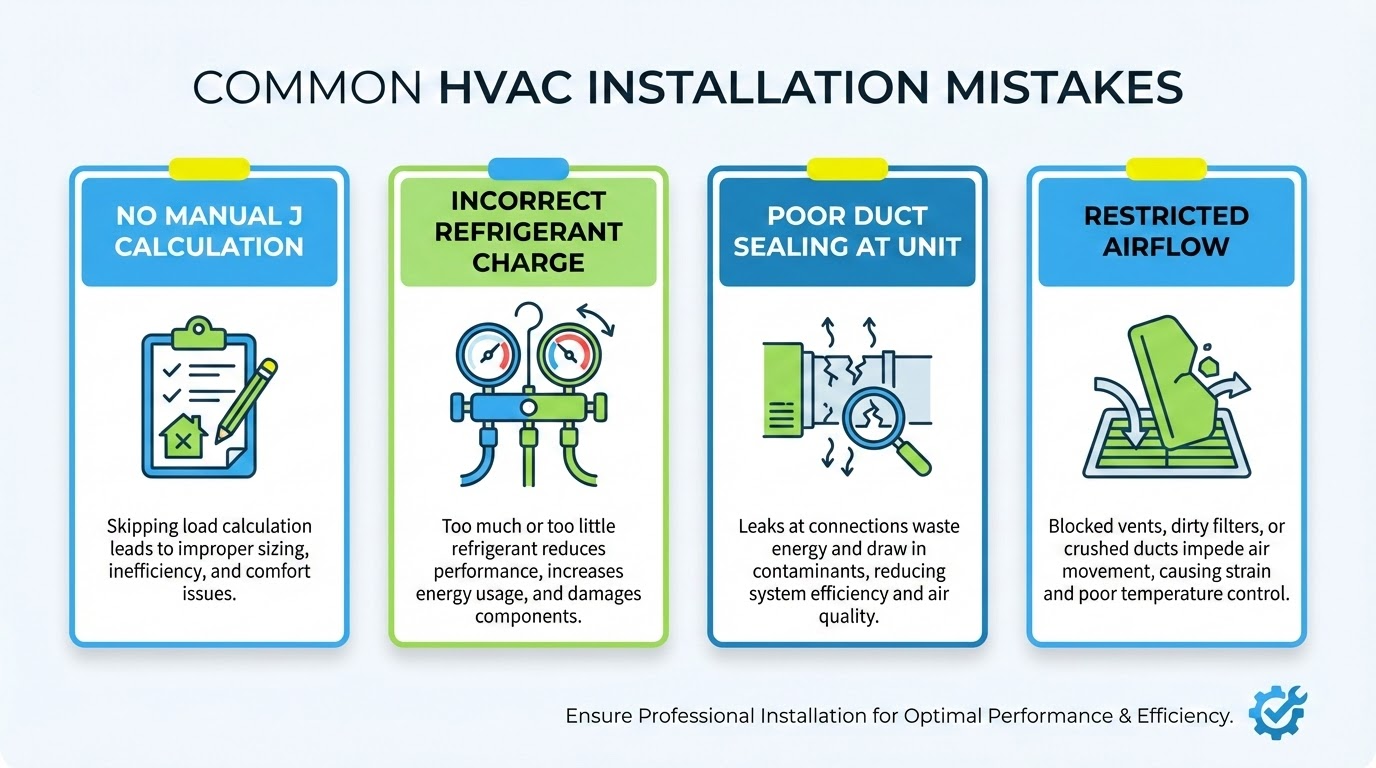
Homeowners sometimes invest in high-efficiency equipment only to find electricity bills remain stubbornly high. Several common mistakes explain this disconnect. Oversizing remains prevalent. Contractors who skip load calculations often default to matching the previous system’s capacity or going bigger as a hedge. Improper refrigerant charge, either too much or too little, degrades efficiency and can damage equipment over time. Inadequate airflow across the evaporator coil, whether from restrictive ductwork or dirty filters, reduces capacity and efficiency simultaneously.
Installation shortcuts also undermine performance. Failing to seal connections at the air handler, not verifying proper static pressure, and neglecting commissioning procedures all contribute to systems that never achieve rated efficiency. The equipment may carry an impressive SEER2 number, but real-world performance falls short because the installation did not support optimal operation.
| Common Installation Mistake | Efficiency Impact | How to Verify |
|---|---|---|
| No Manual J calculation | System may be over or undersized | Ask for load calculation documentation |
| Incorrect refrigerant charge | Up to 20% efficiency loss | Request superheat/subcooling verification |
| Poor duct sealing at unit | Significant air loss at air handler | Visual inspection, pressure testing |
| Restricted airflow | Reduced capacity, higher energy use | Static pressure measurement |
Quick Actions That Lower Energy Bills Before Replacing Equipment
Not every comfort or efficiency problem requires new equipment. Several maintenance and operational adjustments can yield meaningful improvements with minimal investment. Neglected maintenance allows performance to decline over time, increasing energy consumption while reducing cooling capacity.
Filter maintenance stands out as the simplest high-impact action. Clogged filters restrict airflow, forcing the system to work harder while delivering less cooling. Checking filters monthly and replacing them when visibly dirty maintains optimal airflow. Homes with pets, recent construction, or high dust levels may require more frequent replacement. Coil cleaning also matters. Dirty evaporator and condenser coils insulate the heat exchange surfaces, reducing efficiency. Annual professional maintenance typically includes coil inspection and cleaning along with refrigerant charge verification and electrical connection checks.
Thermostat programming offers another opportunity. Adjusting temperature settings by 7 to 10 degrees for eight hours daily can reduce annual heating and cooling costs by approximately 10 percent. Smart thermostats simplify this by learning household patterns and adjusting automatically. Avoiding dramatic temperature swings helps too. Setting the thermostat extremely low when arriving home forces the system into prolonged high-intensity operation rather than maintaining steady, efficient conditions.
Flat Rates | No Hidden Fees | Same-Day Service Available
Financial Incentives That Help Offset Energy-Efficient HVAC Costs

Federal tax credits can reduce the effective cost of qualifying high-efficiency equipment. The Energy-Efficient Home Improvement Credit, available through December 31, 2032, covers central air conditioners meeting specific efficiency thresholds. Systems installed in 2025 and beyond must meet elevated SEER2 and EER2 requirements to qualify. Homeowners claim the credit using IRS Form 5695 when filing annual tax returns.
Local utility rebates may provide additional savings depending on the specific utility provider serving the home. CenterPoint Energy and other Houston-area utilities periodically offer rebates for qualifying equipment upgrades or home performance improvements. Checking directly with the utility before purchasing helps identify current programs and any documentation requirements. Some manufacturers also offer promotional rebates that can stack with other incentives during certain periods.
How to Choose an HVAC Contractor Who Delivers Actual Efficiency
The contractor performing installation has as much impact on real-world efficiency as the equipment itself. Technicians who understand proper sizing, ductwork integration, refrigerant handling, and system commissioning ensure that high-efficiency equipment actually performs to its rating. Credentials matter. NATE certification indicates technicians have demonstrated competency through industry-recognized testing. Experience with energy-efficient systems specifically matters since advanced equipment often requires different installation and configuration approaches than basic models.
Questions to ask before selecting a contractor include whether they perform Manual J load calculations for every installation, whether they inspect and test existing ductwork as part of the replacement process, what commissioning procedures they follow to verify proper operation, and whether they provide documentation of the completed work. Transparent communication about these processes indicates a contractor focused on performance rather than simply completing a quick installation.
“Very responsive and professional. They got me on their schedule day after I called. The technicians were knowledgeable and took time to explain everything.”
How Clean Air Houston Pro Supports Energy Efficiency Goals
Achieving genuine energy efficiency requires attention to the complete system. Equipment selection, proper sizing, ductwork condition, installation quality, and ongoing maintenance all play critical roles. Clean Air Houston Pro approaches each project with this comprehensive perspective. Load calculations inform equipment recommendations rather than rules of thumb. Duct inspection identifies issues that would undermine new equipment performance. Installation procedures follow manufacturer specifications and industry best practices.
Ongoing maintenance services help preserve efficiency over time. Regular filter changes, coil cleaning, refrigerant verification, and electrical inspection catch developing problems before they escalate into comfort complaints or equipment failures. This systematic approach means homeowners actually experience the lower bills and improved comfort that efficient equipment promises. Not just on paper, but in daily operation.
| Homeowner Need | How Clean Air Houston Pro Helps |
|---|---|
| Accurate system sizing | Manual J load calculations for every installation |
| Ductwork performance | Inspection, testing, and sealing services |
| Humidity management | Equipment selection optimized for Houston climate |
| Long-term efficiency | Maintenance plans that preserve system performance |
Frequently Asked Questions About Energy-Efficient HVAC in Houston
+
+
+
+
+
+
Houston’s climate demands HVAC systems that perform efficiently under challenging conditions. The right equipment, properly sized and professionally installed, delivers measurable savings and noticeably better comfort.
Flat Rates | No Hidden Fees | Same-Day Service Available

