
Reading Time: 5 minutes
Carbon Monoxide Detector Houston: A Complete Safety Guide for Homeowners
- Carbon monoxide is colorless and odorless, making electronic detectors the only reliable way to identify dangerous CO levels in your Houston home.
- Install CO detectors on every floor, outside each sleeping area, and near attached garages — most Houston homes need 2 to 6 units for adequate coverage.
- CO detectors last 5 to 7 years on average; check the manufacture date and replace expired units immediately to maintain reliable protection.
- Standard CO detectors cannot detect natural gas leaks — these are different hazards requiring different sensors and separate safety protocols.
- Houston’s storm season, generator use, and tightly sealed homes create elevated CO risks that make professional inspections and clean ductwork essential for safety.
+
- Why Is Carbon Monoxide Especially Dangerous in Houston Homes?
- Do You Need a Carbon Monoxide Detector If You Have Gas Appliances?
- What Are the Symptoms of Carbon Monoxide Poisoning?
- Where Should You Place a Carbon Monoxide Detector?
- How Many CO Detectors Does a Typical Houston Home Need?
- Bedroom vs. Hallway Placement
- A Common Mistake: Installing Too Close to the Furnace
- Can a CO Detector Also Detect Natural Gas Leaks?
- What Does a Professional Carbon Monoxide Inspection Include?
- Comparing CO Inspection, CO Testing, and Gas Leak Detection
- How to Handle a CO Alarm Correctly
- Why Does My CO Detector Keep Going Off?
- How Long Does a Carbon Monoxide Detector Last?
- Step-by-Step CO Detector Installation for Houston Homeowners
- CO Inspection vs. Gas Leak Detection in Practice
- What to Do Immediately When Your CO Alarm Sounds
- Houston-Specific Risks: Generators, Storms, and Seasonal Patterns
- How Clean Air Houston Pro Supports Whole-Home Air Safety
- Frequently Asked Questions
Carbon monoxide is often called the silent killer, and for good reason. This colorless, odorless, and tasteless gas is virtually impossible to detect without the right technology. For Houston homeowners, the risk is real and recurring — especially during severe weather events, power outages, and cold snaps when generators, portable heaters, and gas appliances see heavy use. A reliable carbon monoxide detector in your Houston home is not a luxury; it is a fundamental layer of protection for everyone under your roof.
Understanding how CO enters your living space, where to place detectors, and what to do when an alarm sounds can mean the difference between a close call and a tragedy. The information in this guide draws on recommendations from the EPA, the Texas Department of Insurance, the Mayo Clinic, and local Houston emergency management resources to give you a practical, trustworthy framework for keeping your household safe.
Why Is Carbon Monoxide Especially Dangerous in Houston Homes?
Houston’s subtropical climate means air conditioning runs for most of the year, keeping homes tightly sealed. When temperatures drop unexpectedly — or when hurricanes knock out power for days — residents often turn to backup heating sources, generators, or gas stoves for warmth and electricity. Each of these creates combustion byproducts, and if ventilation is inadequate, CO can accumulate quickly indoors.
According to the Texas Department of Insurance, fuel-burning appliances such as furnaces, water heaters, gas ranges, fireplaces, and portable generators are the most common sources of residential CO. In a well-sealed Houston home — particularly one that has invested in energy-efficient attic insulation services — proper ventilation and functional CO detection become even more critical, because tight building envelopes reduce natural air exchange.
Do You Need a Carbon Monoxide Detector If You Have Gas Appliances?
Yes. If your home contains any fuel-burning appliance — a gas furnace, gas water heater, gas stove, fireplace, or an attached garage where a vehicle idles — a carbon monoxide detector is strongly recommended. Even a properly maintained appliance can produce trace amounts of CO during normal operation. A cracked heat exchanger, a blocked flue, or a malfunctioning burner can escalate those trace amounts to dangerous levels without any visible sign.
Texas Senate Bill 338 established Chapter 766 of the Texas Health and Safety Code, which addresses carbon monoxide alarm requirements in certain residential settings involving fossil-fuel appliances. Whether or not your specific situation falls under a legal mandate, the practical safety argument is clear: a working CO alarm provides an early warning that no human sense can replicate.
What Are the Symptoms of Carbon Monoxide Poisoning — and Why Do They Fool People?
One of the most dangerous characteristics of CO exposure is that early symptoms closely mimic common illnesses. The Mayo Clinic lists dull headache, weakness, dizziness, nausea or vomiting, shortness of breath, confusion, and blurred vision as key warning signs. Because these overlap with flu-like conditions, many people dismiss them — especially during winter months when both the flu and heater use are common.
A critical clue is whether multiple household members experience similar symptoms simultaneously, or whether symptoms improve noticeably after leaving the house. Children, elderly family members, and individuals with chronic heart or respiratory conditions are particularly vulnerable. This is precisely why electronic detection matters: a carbon monoxide detector does not guess, does not sleep, and does not mistake poisoning for a headache.
“They did a fantastic job. The Houston allergens and poor air quality in my home were problematic. Scheduling was easy, and the team was professional and thorough.”
Where Should You Place a Carbon Monoxide Detector in Your Home?
Proper placement determines whether your detector can actually protect you. The general principle is straightforward: install a CO alarm on every level of the home, outside each sleeping area where you will hear the alarm at night, and near — but not directly on top of — fuel-burning appliances. The U.S. EPA recommends a central location on each floor plus additional units near attached garages and rooms above garages.
Recommended Locations by Room
The hallway adjacent to bedrooms is the single most important spot — it ensures the alarm wakes sleeping occupants. On a second story, place a detector near the top of the stairway. If your home has a basement with a furnace, water heater, or workshop, an alarm in that space adds a valuable early-warning layer. In homes with an attached garage, a detector on the interior wall near the garage entry door helps catch CO that may migrate from a running vehicle or stored equipment.
Where Not to Install a CO Detector
Avoid placing detectors directly inside kitchens (cooking byproducts cause nuisance alarms), inside bathrooms (humidity interferes with sensors), directly above or beside a fuel-burning appliance (momentary combustion byproducts trigger false alerts), behind curtains or furniture (blocks airflow to the sensor), and in direct drafts from HVAC registers or open windows. A minimum distance of 15 to 20 feet from combustion appliances is a widely cited guideline for reducing false alarms while maintaining protection.
Our certified technicians use calibrated instruments to test air quality and inspect every fuel-burning appliance in your home. Know your CO risk — not just guess.
Or call us: (832) 737-8500
How Many CO Detectors Does a Typical Houston Home Need?
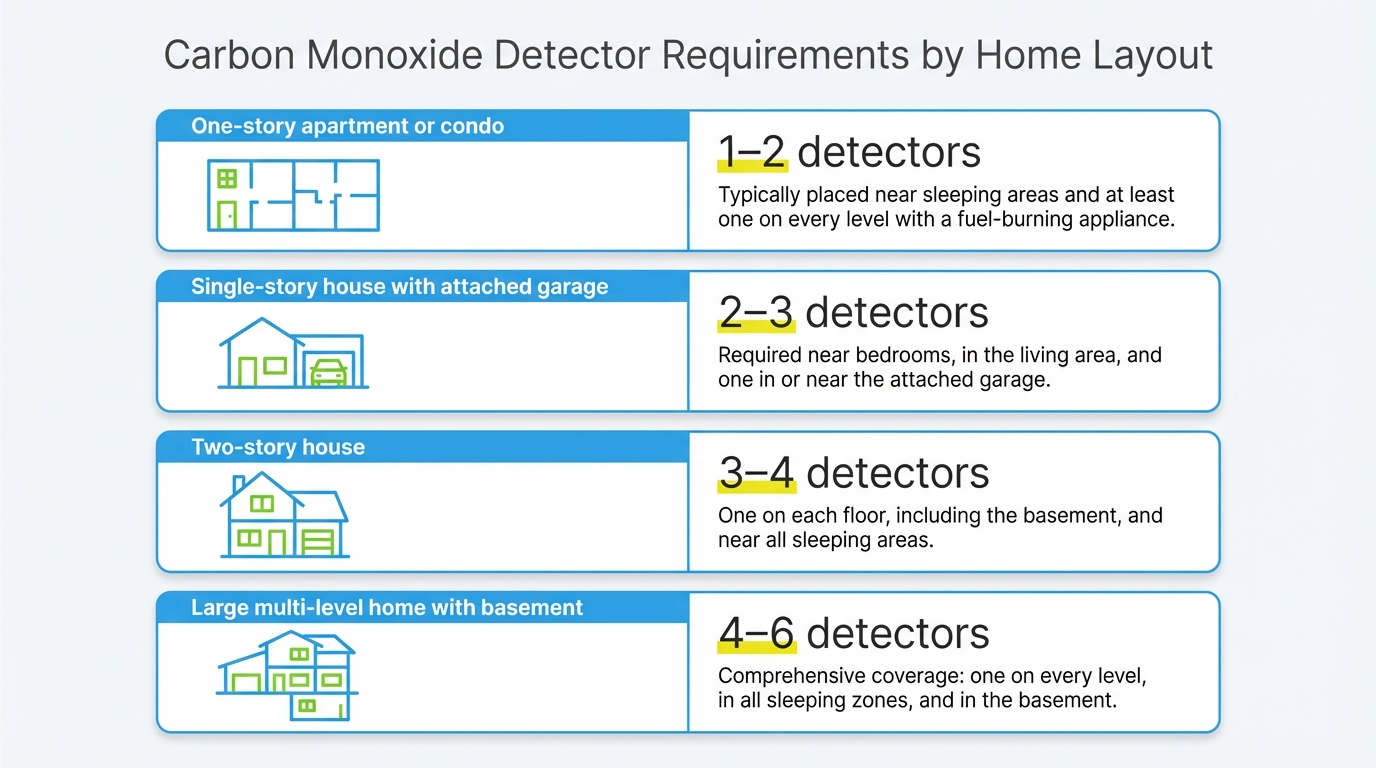
The answer depends on the size and layout of your home. A single-story, two-bedroom home may need only two detectors — one near the sleeping area and one near the primary fuel-burning appliance zone. A two-story home with an attached garage and multiple sleeping areas might need four or more units to ensure adequate coverage.
| Home Layout | Minimum Detectors Recommended | Key Placement Notes |
|---|---|---|
| One-story apartment or condo | 1 to 2 | Near bedroom hallway and near any gas appliance |
| Single-story house with attached garage | 2 to 3 | Add one near the garage entry wall |
| Two-story house | 3 to 4 | One per floor plus outside each sleeping zone |
| Large multi-level home with basement | 4 to 6 | Basement near furnace zone, each floor, each sleeping area cluster |
These are starting guidelines. Homes with multiple gas appliances, long hallways, or unusual floor plans may benefit from additional units. When in doubt, more coverage is better than less.
Should You Place a Detector Inside the Bedroom or in the Hallway?
For most homes, the hallway immediately outside bedrooms is the priority — this single location protects multiple rooms and is the standard recommendation from the CPSC. However, if household members sleep with bedroom doors closed, a hallway alarm may be muffled enough to miss. In that scenario, adding a detector inside each closed bedroom provides a stronger safety margin. Follow the manufacturer’s mounting instructions for wall height or ceiling placement, as this varies by model.
A Common Mistake: Installing a CO Alarm Too Close to the Furnace
Many homeowners assume that mounting the detector right next to the furnace or water heater will catch problems fastest. In reality, placing it too close — within just a few feet — often results in nuisance alarms caused by brief, normal combustion byproducts during startup cycles. This leads to frustration, alarm fatigue, and eventually the dangerous habit of ignoring or disconnecting the device.
Practical Distance Guidelines
A distance of roughly 15 to 20 feet from the appliance, in the same general zone or room, typically provides reliable detection without constant false triggers. If the mechanical room is small and distance is limited, mount the detector just outside the room’s doorway. Always consult the specific detector’s manual — some models have different sensitivity thresholds and distance recommendations.
Can a Carbon Monoxide Detector Also Detect a Natural Gas Leak?
This is one of the most common and most dangerous misconceptions. A standard carbon monoxide detector measures CO — a byproduct of incomplete combustion. Natural gas (methane) is a fuel, and a leak represents a fire and explosion hazard rather than a slow-poisoning hazard. These are different gases requiring different sensors.
Some combination detectors on the market include sensors for both CO and combustible gases, but you must read the product specifications carefully. Relying on a CO-only detector to warn you about a natural gas leak could leave a critical gap in your safety plan. If you smell the distinctive rotten-egg odor added to natural gas, follow Texas Gas Service safety protocols: leave the area immediately without operating switches or electronics, and call 911 from a safe distance.
“Stacy’s team was awesome fast and professional! They explained everything to me before they did anything. Very fair pricing. I will definitely use them again.”
What Does a Professional Carbon Monoxide Inspection Include?
A professional carbon monoxide inspection goes well beyond checking whether your detector beeps when you press the test button. A trained technician typically uses calibrated ambient air monitors to measure real-time CO levels throughout the home. They then inspect each fuel-burning appliance — furnace, water heater, stove, fireplace — for proper combustion, adequate draft, and intact venting. Heat exchangers are examined for cracks, chimney flues for blockages, and exhaust connectors for corrosion or disconnection.
Restricted airflow through ductwork can also contribute to backdrafting, a condition where exhaust gases are pulled back into the home instead of venting outside. This is one reason that maintaining clean ventilation through professional air duct cleaning supports not just comfort and efficiency, but also safety. When ducts are clogged with debris, the HVAC system’s airflow balance can shift enough to affect combustion appliance venting.
Comparing CO Inspection, CO Testing, and Gas Leak Detection
These terms are sometimes used interchangeably, but they refer to distinct services with different scopes and equipment.
| Service | What It Measures | Primary Hazard Addressed | Typical Equipment |
|---|---|---|---|
| CO Testing | Parts per million of carbon monoxide in ambient air | Poisoning from incomplete combustion | Calibrated CO meter / ambient air monitor |
| Carbon Monoxide Inspection | CO levels plus appliance condition, venting integrity, draft | Identifying the source and preventing future buildup | CO meter, combustion analyzer, visual inspection tools |
| Gas Leak Detection | Presence of combustible gas (methane, propane) in gas lines | Fire, explosion, and secondary CO risk | Combustible gas sniffer / electronic leak detector |
For Houston homes with multiple gas appliances, scheduling both a CO inspection and a gas leak detection check as part of annual maintenance provides the most thorough protection. A fuel-burning appliance with a small leak can produce both a gas hazard and elevated CO — the two risks overlap more often than homeowners realize.
Flat Rates | No Hidden Fees | Same-Day Service Available
How to Handle a CO Alarm Correctly: Full vs. Low-Battery Beep
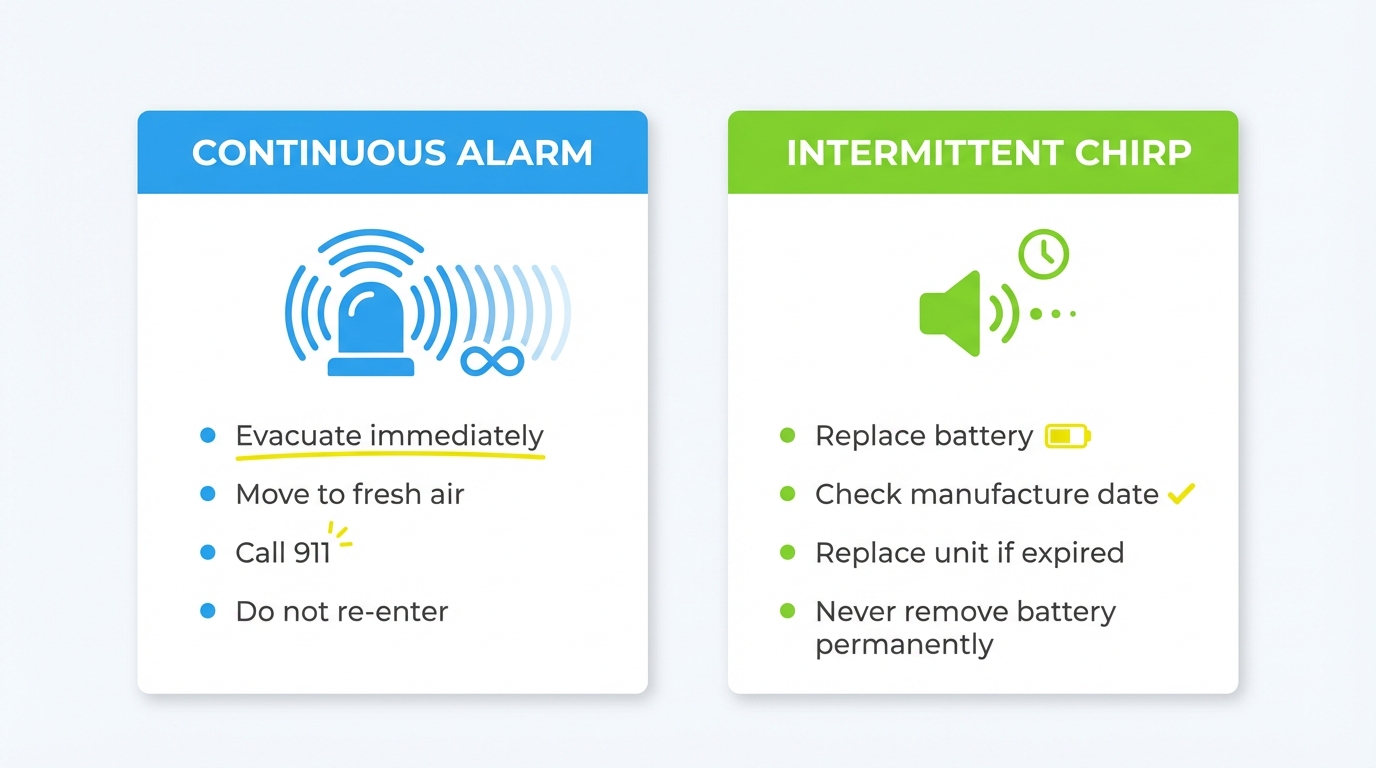
Not every beep means the same thing, and understanding the difference can prevent both panic and complacency.
Continuous Alarm (Loud, Repeating Pattern)
This signals detected carbon monoxide above the alarm threshold. The correct response is immediate: stop what you are doing, gather all household members and pets, exit the home, move to fresh outdoor air, and call 911. Do not re-enter the home until emergency responders or a qualified professional have confirmed it is safe. Do not attempt to locate the CO source yourself — every minute of exposure increases the risk.
Intermittent Chirp (Single Beep Every 30 to 60 Seconds)
This typically indicates a low battery or an end-of-life warning rather than detected CO. Replace the battery first. If chirping continues with a fresh battery, check the manufacture date on the back of the unit — if the detector is past its rated lifespan, it needs to be replaced entirely. Never remove the battery and forget to reinstall it. That single decision has contributed to preventable tragedies documented by fire departments across Texas.
Why Does My CO Detector Keep Going Off for No Apparent Reason?
Repeated false alarms frustrate homeowners, but they usually have an identifiable cause. The most common culprits include incorrect placement (too close to a stove, bathroom, or humid area), dust or debris buildup on the sensor, an aging sensor nearing end-of-life, or strong drafts from HVAC vents pushing transient combustion byproducts toward the detector during appliance startup.
Before concluding that an alarm is “false,” take it seriously at least once — ventilate the home and check that all appliances are operating normally. If the pattern persists after verifying placement, replacing batteries, and confirming the unit is within its service life, a professional CO inspection can determine whether low-level CO is actually present intermittently. Clean Air Houston Pro’s inspection-first approach uses calibrated instruments rather than guesswork to identify whether the issue is environmental or equipment-related.
How Long Does a Carbon Monoxide Detector Last Before Replacement?
CO detectors are not lifetime devices. The electrochemical sensor inside gradually degrades, and after a certain number of years it can no longer reliably detect CO at safe threshold levels. Most manufacturers rate their units for five to seven years, with some models extending to ten years. The unit’s end-of-life warning — usually a distinct chirp pattern different from the low-battery signal — is the clearest indicator that replacement is due.
Check the manufacture date printed on the back or side of every detector in your home. If you cannot find a date or the unit is clearly old, replace it. Spending a modest amount on a new detector is far less costly than the risk of relying on a sensor that can no longer do its job. Monthly testing by pressing the test button confirms the alarm horn works, but it does not confirm that the sensor is still accurate — only age and manufacturer specifications determine that.
Step-by-Step CO Detector Installation for Houston Homeowners
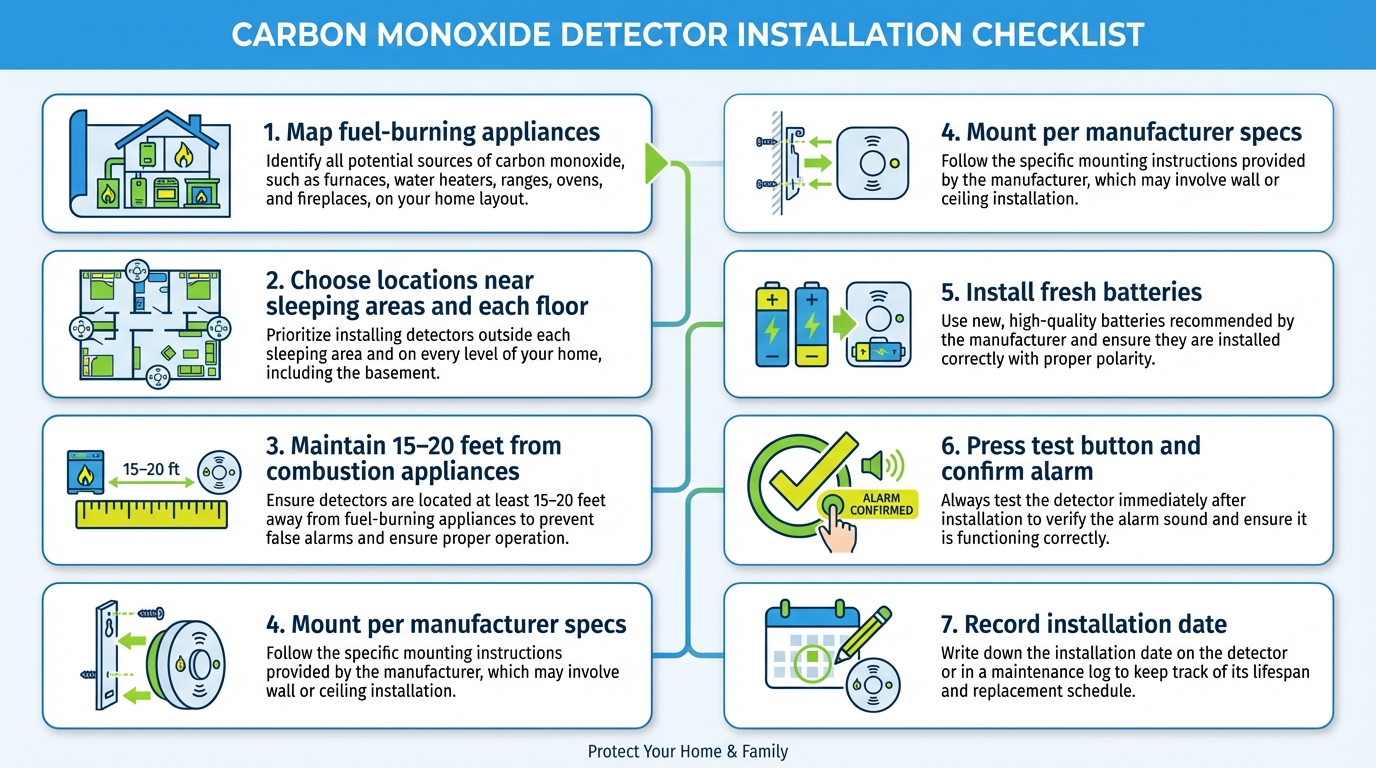
Proper CO detector installation is a combination of choosing the right locations, mounting at the correct height, and verifying operation. Here is a practical checklist that applies to most residential situations.
Installation Checklist
| Step | Action | Why It Matters |
|---|---|---|
| 1 | Map every fuel-burning appliance and attached garage in your home | Identifies all potential CO sources |
| 2 | Choose locations: hallway outside sleeping areas, each floor, near garage entry | Ensures audible coverage during sleep and layered detection |
| 3 | Maintain 15 to 20 feet from combustion appliances | Reduces nuisance alarms without sacrificing safety |
| 4 | Mount per manufacturer specs (wall or ceiling depending on model) | Sensor performance varies by orientation |
| 5 | Install fresh batteries or confirm hardwired backup battery is seated | Prevents immediate low-battery chirps |
| 6 | Press the test button and confirm loud alarm sounds throughout the area | Validates the horn and basic electronics |
| 7 | Record the installation date on the unit with a marker | Simplifies future replacement scheduling |
When a Professional Installer Makes Sense
For larger homes with complex HVAC zoning, multiple gas appliances, or a history of recurring alarms, professional assessment can pinpoint optimal locations and identify underlying issues — such as backdrafting or duct leakage — that a DIY approach might miss. Combining detector installation with routine maintenance like dryer vent cleaning and duct inspection creates a comprehensive fire and gas safety routine that covers multiple risk areas in a single visit.
Air duct inspection, dryer vent assessment, and ventilation review — all in one visit. Our flat-rate pricing means no surprises.
Or call us: (832) 737-8500
What Is the Difference Between a Carbon Monoxide Inspection and Gas Leak Detection in Practice?
Homeowners frequently ask whether one service covers both risks. The short answer is no — but the two complement each other. A carbon monoxide inspection focuses on combustion safety: is each appliance burning fuel completely, is exhaust venting correctly, and are CO levels in the living space within safe limits? Gas leak detection focuses on fuel delivery integrity: are gas lines, connectors, valves, and fittings sealed properly so that unburned fuel is not escaping into the home?
A malfunctioning appliance can create both problems simultaneously — a cracked heat exchanger might allow CO to enter the airstream while also permitting a small gas leak at the burner assembly. This is why bundling both checks during a single professional visit makes practical sense and provides a more complete safety picture for your household.
What to Do Immediately When Your CO Alarm Sounds
When a carbon monoxide alarm activates with a continuous pattern, treat it as a real emergency every single time. Move all people and pets outside to fresh air. Do not stop to open windows or investigate the source — your priority is evacuation. Once outside and at a safe distance, call 911 and report a carbon monoxide alarm. Do not re-enter the home until fire department personnel or a qualified technician has cleared it.
If anyone shows symptoms of CO exposure — headache, confusion, dizziness, nausea — inform the 911 dispatcher so that medical response can be coordinated. After the immediate emergency is resolved, a thorough follow-up inspection of all combustion appliances and venting systems is essential before resuming normal use of the home. Clean Air Houston Pro provides post-incident inspections using calibrated monitoring equipment to verify that CO levels are safe and that the source has been identified and addressed — giving families confidence to return home without guesswork.
“Very responsive and professional. They got me on their schedule day after I called. The technicians were knowledgeable and took time to explain everything.”
Houston-Specific Risks: Generators, Storms, and Seasonal Patterns
Houston’s weather pattern creates a unique CO risk profile. Tropical storms and hurricanes cause extended power outages that push residents toward portable generators — the single largest contributor to CO fatalities in post-storm Texas, according to the Texas Department of Insurance. A generator must never be operated inside a home, garage, carport, or within 20 feet of any window, door, or vent opening.
During rare cold events, furnaces that have sat idle for months may start up with compromised venting or cracked components. A pre-season HVAC inspection — including combustion analysis and vent integrity checks — is a practical step that can catch problems before they turn into CO incidents. Pairing this with annual duct maintenance helps ensure that airflow dynamics support proper appliance venting rather than working against it.
How Clean Air Houston Pro Supports Whole-Home Air Safety
Addressing CO risk effectively requires more than a single device on the wall. It involves a holistic view of how air moves through your home — from supply ducts and return vents to exhaust flues and dryer vents. Clean Air Houston Pro approaches indoor air safety with an inspection-first methodology, using HEPA-filtered equipment and negative-pressure techniques to clean ductwork without spreading contaminants. This process also reveals conditions like disconnected duct runs, blocked returns, or debris near furnace compartments that could affect combustion appliance performance.
Flat-rate pricing with no hidden fees means homeowners can plan maintenance budgets with confidence. Whether the need is a routine duct cleaning, a dryer vent inspection for fire safety, or a post-alarm assessment to rule out lingering CO issues, the goal is always the same: cleaner airflow and safer system operation throughout your Houston home.
Frequently Asked Questions
+
+
+
+
+
+
Whether you need a duct inspection, post-alarm air quality assessment, or a complete ventilation review, the team at Clean Air Houston Pro is here to help Houston homeowners breathe easier and live safer.
Flat Rates | No Hidden Fees | Same-Day Service Available

