
Reading Time: 5 minutes
HEPA Filter Installation Houston: A Professional Guide to Cleaner Indoor Air
- True HEPA filters capture 99.97% of particles at 0.3 microns, far surpassing standard residential filters and even MERV 13 upgrades
- Forcing a HEPA filter into a standard HVAC slot without professional assessment can damage your blower motor and freeze your evaporator coil
- Houston’s extended cooling season and high pollen levels mean filters load up faster here than manufacturer estimates typically suggest
- HEPA filtration captures airborne particles but does not remove gases, odors, or active mold growth — a professional evaluation identifies what your property actually needs
- Clean Air Houston Pro uses an inspection-first approach with flat-rate pricing, post-installation airflow verification, and a clear maintenance plan for every project
+
- Why Houston Properties Need Advanced Indoor Air Filtration
- What “HEPA” Really Means and Why the 0.3 Micron Standard Matters
- How a Whole-Home Air Filtration System Integrates with Your HVAC
- The Costly Mistake of Forcing HEPA into a Standard Filter Slot
- HEPA vs. MERV 13: Which One Does Your Property Actually Need?
- What a HEPA Air Purifier Cannot Do
- Can HEPA Filtration Help with Allergies and Asthma?
- What a Professional HEPA Filter Installation in Houston Looks Like
- How Houston’s Climate Affects Your Filter Replacement Schedule
- Warning Signs Your Current Filtration Is Not Keeping Up
- HEPA-Type Labels vs. True HEPA Performance
- In-Duct HEPA vs. Portable Units: Which Fits Your Property?
- What Influences the Cost of HEPA Filter Installation in Houston?
- A Practical Checklist Before You Schedule Installation
- How Clean Air Houston Pro Approaches Filtration Projects Differently
- Frequently Asked Questions
Why Houston Properties Need Advanced Indoor Air Filtration
Houston homeowners and business owners face a unique set of indoor air quality challenges. Between the year-round humidity, seasonal pollen surges, and elevated particulate levels common across the Gulf Coast, the air inside your property can carry a heavier load of allergens and irritants than you might expect. The Texas Commission on Environmental Quality (TCEQ) actively monitors PM2.5 and PM10 levels throughout the state, and Houston consistently registers readings that underscore why indoor filtration matters so much here.
HEPA filter installation in Houston has become the go-to upgrade for property owners who want measurable improvement in indoor air quality — not just a slightly better disposable filter. A HEPA air purifier integrated into your HVAC system or installed as a dedicated unit can capture the microscopic particles that standard filters simply let pass through. For households with allergy or asthma sufferers, or for commercial spaces that need consistent air cleanliness, professional installation is the practical path forward.
Before any filtration upgrade can perform at its best, the ductwork itself needs to be clean. That is why pairing this investment with professional air duct cleaning sets a solid foundation for the system to do its job effectively.
“They did a fantastic job. The Houston allergens and poor air quality in my home were problematic. Scheduling was easy, and the team was professional and thorough.”
What “HEPA” Really Means and Why the 0.3 Micron Standard Matters
HEPA stands for High Efficiency Particulate Air. According to the U.S. Environmental Protection Agency (EPA), a true HEPA filter must remove at least 99.97 percent of airborne particles that measure 0.3 microns in diameter. That specific size is not chosen arbitrarily. Particles at 0.3 microns represent the most penetrating particle size — they are the hardest for any filter medium to capture. If a filter can stop 99.97 percent of those, it will catch an even higher percentage of both larger and smaller particles.
This is what separates a genuine high efficiency filter from the flat fiberglass panels or basic pleated filters you pick up at a hardware store. Standard residential filters typically range from MERV 1 to MERV 8. Even a MERV 13 filter, which is a significant upgrade, does not reach HEPA-level performance on the smallest particles. Understanding this distinction helps you make an informed decision about what level of filtration your property actually needs.
How a Whole-Home Air Filtration System Integrates with Your HVAC
A whole-home air filtration system connects directly to your existing HVAC ductwork so that all conditioned air passes through the filter medium before reaching your living or working spaces. This sounds straightforward, but there is a critical engineering detail that many homeowners overlook: true HEPA media is extremely dense. Forcing all of your system’s airflow through that dense material can strain the blower motor and dramatically reduce airflow if the system is not designed for it.
That is why many professional HEPA installations use a bypass configuration. A dedicated, motorized HEPA unit draws a portion of air from the return duct, filters it, and sends it back into the supply side — without forcing the main AC blower to work against excessive resistance. The clean air filter housing must also seal tightly against the frame. Any gap allows unfiltered air to bypass the media entirely, which defeats the purpose of the upgrade.
As the CDC/NIOSH guidance on improving air cleanliness emphasizes, inspecting filter fit to minimize bypass is a critical step that is easy to overlook during a DIY attempt.
Our technicians measure static pressure and assess your system before recommending any equipment. No guesswork, no risk to your HVAC.
Or call us: (832) 737-8500
The Costly Mistake of Forcing HEPA into a Standard Filter Slot
One of the most frequent errors homeowners make is purchasing a filter labeled “HEPA” or “HEPA-type” and sliding it into the existing one-inch filter slot on their HVAC system. This approach creates several problems at once. The increased resistance — known as static pressure — forces the blower motor to work significantly harder. Over weeks or months, this can lead to motor burnout, frozen evaporator coils, and higher energy bills. ASHRAE has issued clear warnings that upgrading to higher efficiency filters increases pressure drop and can reduce airflow unless the system is modified accordingly.
A professional evaluation before installation is not optional — it is essential. The technician needs to measure the system’s current static pressure, assess the blower’s capacity, and determine whether a bypass unit, a larger filter housing, or a standalone commercial unit is the right solution for your specific setup.
HEPA vs. MERV 13: Which One Does Your Property Actually Need?
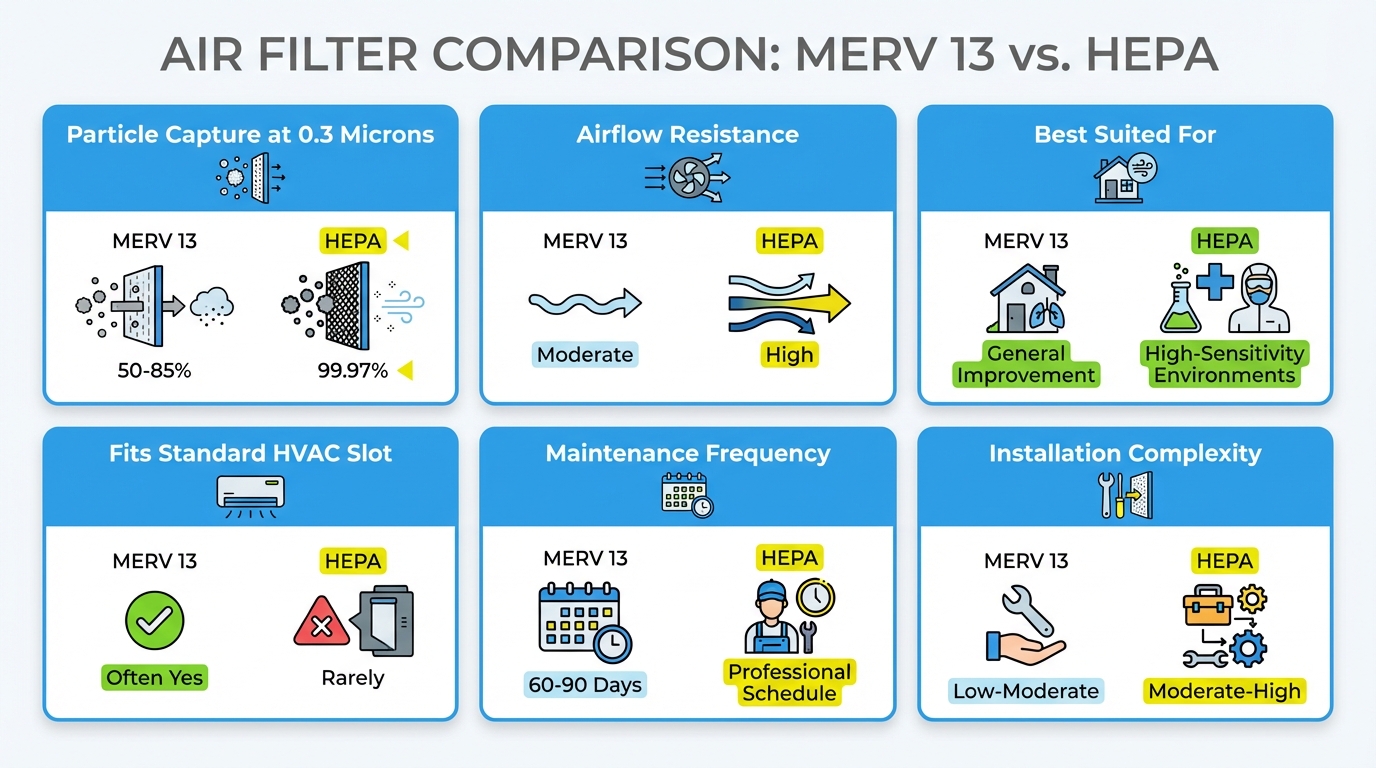
| Criteria | MERV 13 Filter | True HEPA Filter |
|---|---|---|
| Particle capture at 0.3 microns | Approximately 50-85 percent | 99.97 percent minimum |
| Airflow resistance | Moderate increase over standard filters | High — often requires bypass or dedicated unit |
| Fits standard HVAC slot | Often yes, with proper sizing | Rarely without modification |
| Best suited for | General improvement, most homes and offices | High-sensitivity environments, medical concerns, heavy particulate loads |
| Maintenance frequency | Every 60-90 days typically | Varies by unit; professional schedule recommended |
| Installation complexity | Low to moderate | Moderate to high — professional installation recommended |
For many Houston properties, a properly installed MERV 13 filter provides a strong balance between improved air quality and manageable airflow resistance. But when occupants have documented respiratory conditions, when the building is near construction or industrial activity, or when the goal is the highest level of particulate removal achievable, a true HEPA system is the appropriate choice. The key is matching the solution to the actual need — and to the mechanical capacity of your existing HVAC equipment.
What a HEPA Air Purifier Cannot Do
HEPA filtration is exceptionally effective at capturing solid particles: dust, pollen, pet dander, mold spores, and fine particulate matter. However, it does not remove gases, volatile organic compounds, or odors. If your primary complaint is a chemical smell, cooking odors, or cigarette smoke residue, a HEPA filter alone will not solve the problem. The EPA clearly states that air cleaners without special media such as activated carbon or alumina will not address gaseous pollutants.
This is an important distinction because some providers market HEPA as a catch-all solution. A thorough evaluation should identify whether your indoor air quality issue is particle-driven, gas-driven, or both — and recommend the appropriate combination of filtration media. Some advanced air filtration systems pair HEPA with activated carbon stages specifically to address both categories simultaneously.
Can HEPA Filtration Help with Allergies and Asthma?
Research supports that HEPA filtration can meaningfully reduce indoor particulate concentrations and improve outcomes for people with respiratory sensitivities. A peer-reviewed study published in the National Institutes of Health database found that HEPA air filtration reduced indoor particulate pollution and improved asthma control scores among participants with poorly controlled asthma. Separate randomized trials have shown reductions in indoor PM10 levels when portable HEPA cleaners were used in homes with children who have asthma.
These findings do not guarantee specific health outcomes for every individual — responses vary depending on the severity of the condition, the sources of indoor pollution, and how well the filtration system is maintained. What the evidence does show is that reducing airborne particulate exposure through HEPA-grade filtration is a practical, evidence-supported step that can contribute to a healthier indoor environment.
For households where mold spores are a concern, remember that while a HEPA filter traps airborne spores, any existing mold growth requires professional mold remediation services to address the source directly.
“Stacy’s team was awesome fast and professional! They explained everything to me before they did anything. Very fair pricing. I will definitely use them again.”
What a Professional HEPA Filter Installation in Houston Looks Like
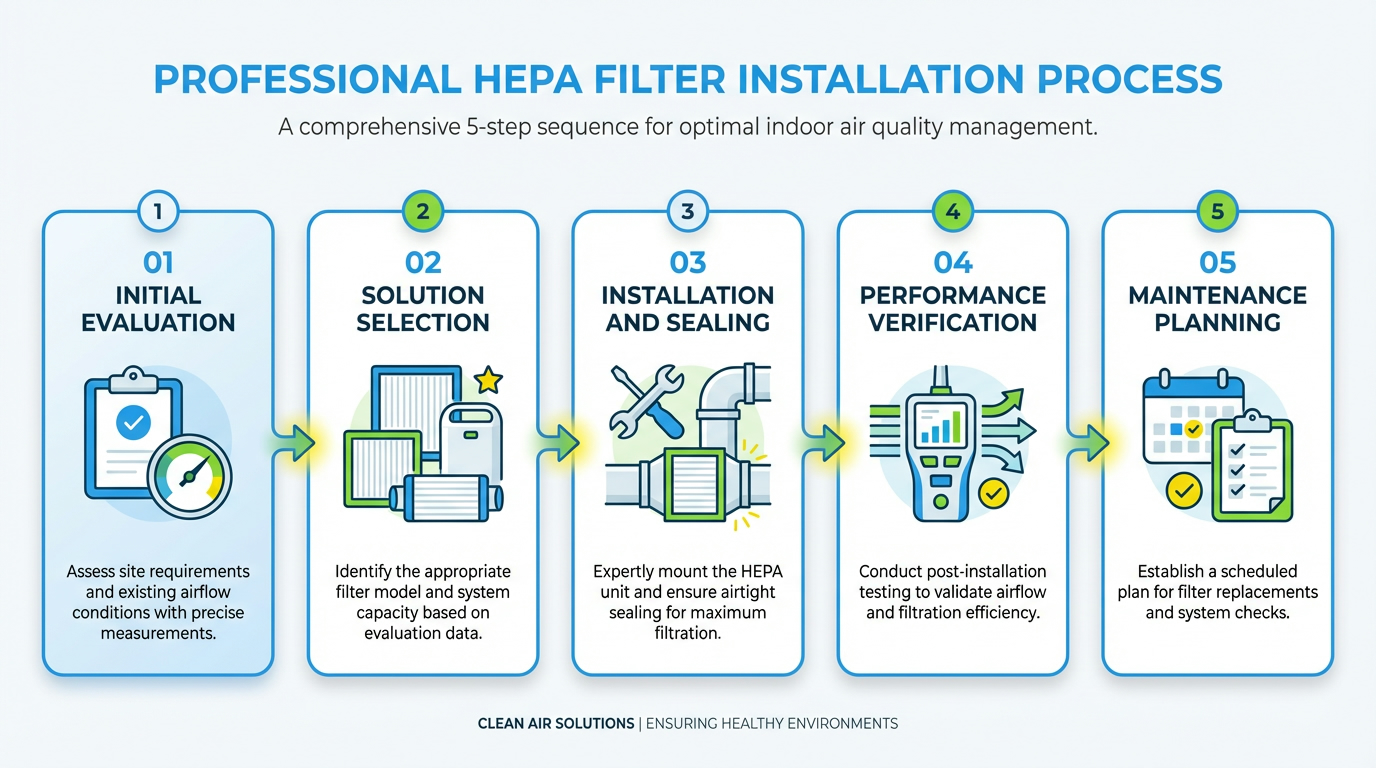
A reliable installation process follows a clear sequence of steps. Cutting corners at any stage compromises the performance of the entire system. Here is what a thorough process typically involves when performed by an experienced team.
| Stage | What Happens | Why It Matters |
|---|---|---|
| Initial evaluation | Technician inspects the HVAC system, measures static pressure, reviews ductwork layout | Determines whether HEPA is compatible or if modifications are needed |
| Solution selection | Recommendation of bypass unit, in-duct housing, or standalone commercial unit based on findings | Prevents mismatched equipment that could damage the system |
| Installation and sealing | Unit is mounted, connected to ductwork, and sealed to prevent air bypass around the filter | Unsealed edges allow unfiltered air through, negating the investment |
| Performance verification | Airflow and static pressure are measured after installation to confirm safe operating parameters | Catches issues before they cause equipment strain or comfort problems |
| Maintenance planning | Technician establishes a replacement schedule and shows the property owner how to check filter condition | A clogged HEPA filter is worse than no filter — it restricts airflow severely |
Clean Air Houston Pro follows an inspection-first approach for every filtration project. The team evaluates your system before recommending any equipment, which means you receive a solution sized to your property — not a one-size-fits-all upsell. This process also includes post-installation airflow verification, so you have confidence the system is performing as intended from day one.
Flat Rates | No Hidden Fees | Same-Day Service Available
How Houston’s Climate Affects Your Filter Replacement Schedule
Houston’s subtropical climate means your HVAC system runs for extended hours throughout much of the year. Air conditioning often operates from March through November, and some properties run systems nearly year-round. That extended runtime pushes more air — and more particulates — through the filter than you would see in a milder climate. Add in Houston’s pollen seasons, construction dust from ongoing development, and the general humidity that encourages biological growth, and you have a recipe for filters that load up faster than manufacturer estimates suggest.
There is no single replacement interval that applies to every property. A commercial space with high foot traffic and doors opening frequently may need filter changes far more often than a tightly sealed residential home. The practical approach is to combine a baseline schedule with regular visual inspections and, ideally, periodic static pressure readings. When pressure across the filter rises beyond the manufacturer’s recommended maximum, it is time for a replacement regardless of what the calendar says.
Warning Signs Your Current Filtration Is Not Keeping Up
Sometimes the evidence is visible before you ever measure anything. Watch for these indicators that your current air filtration is inadequate for your Houston property:
Dust accumulating on surfaces within days of cleaning, visible debris around supply registers, or a musty smell when the system kicks on can all point to inadequate filtration. If occupants report increased allergy symptoms indoors compared to outdoors, that is another signal worth investigating. Uneven airflow from room to room — especially if it has worsened over time — may indicate that the current filter is too restrictive for the system or that bypass around the filter frame is allowing contaminated air through.
In commercial settings, tenant complaints about stuffiness, odor, or dust are often the first indicators. A proactive approach involves scheduling inspections before complaints escalate, which protects both air quality and tenant satisfaction.
HEPA-Type Labels vs. True HEPA Performance
Marketing terminology in the air filtration industry can be misleading. Products labeled “HEPA-type,” “HEPA-style,” or “HEPA-like” are not required to meet the 99.97 percent efficiency standard at 0.3 microns. Some of these filters capture only 85 to 90 percent of particles at that size — a meaningful gap when you are investing in filtration specifically to address health concerns or high particulate loads. The U.S. Department of Energy maintains testing standards for true HEPA filters used in controlled environments, and OSHA’s formal definition aligns with the 99.97 percent threshold.
When evaluating options for your Houston property, ask the provider to confirm the filter meets the DOE or equivalent HEPA standard — not just a marketing claim. A reputable installer will be transparent about the specific filter media being used and its tested efficiency rating.
In-Duct HEPA vs. Portable Units: Which Fits Your Property?
An in-duct air filtration system treats the entire volume of air circulated by your HVAC. This is the preferred approach when you want consistent, building-wide particulate reduction. It requires professional installation and works best in properties with well-sealed, properly maintained ductwork.
A portable HEPA air purifier, on the other hand, treats a single room or zone. It is useful for targeted applications — a nursery, an office where a specific occupant has severe allergies, or a temporary solution while a whole-building system is being planned.
For commercial properties, in-duct systems are almost always the more practical long-term choice because they scale with the building’s HVAC capacity and do not require individual units in every room. Clean Air Houston Pro can assess your property and recommend the configuration that delivers the best results for the investment, whether that means a single bypass HEPA unit on the main trunk line or a combination approach for multi-zone systems.
“Very responsive and professional. They got me on their schedule day after I called. The technicians were knowledgeable and took time to explain everything.”
What Influences the Cost of HEPA Filter Installation in Houston?
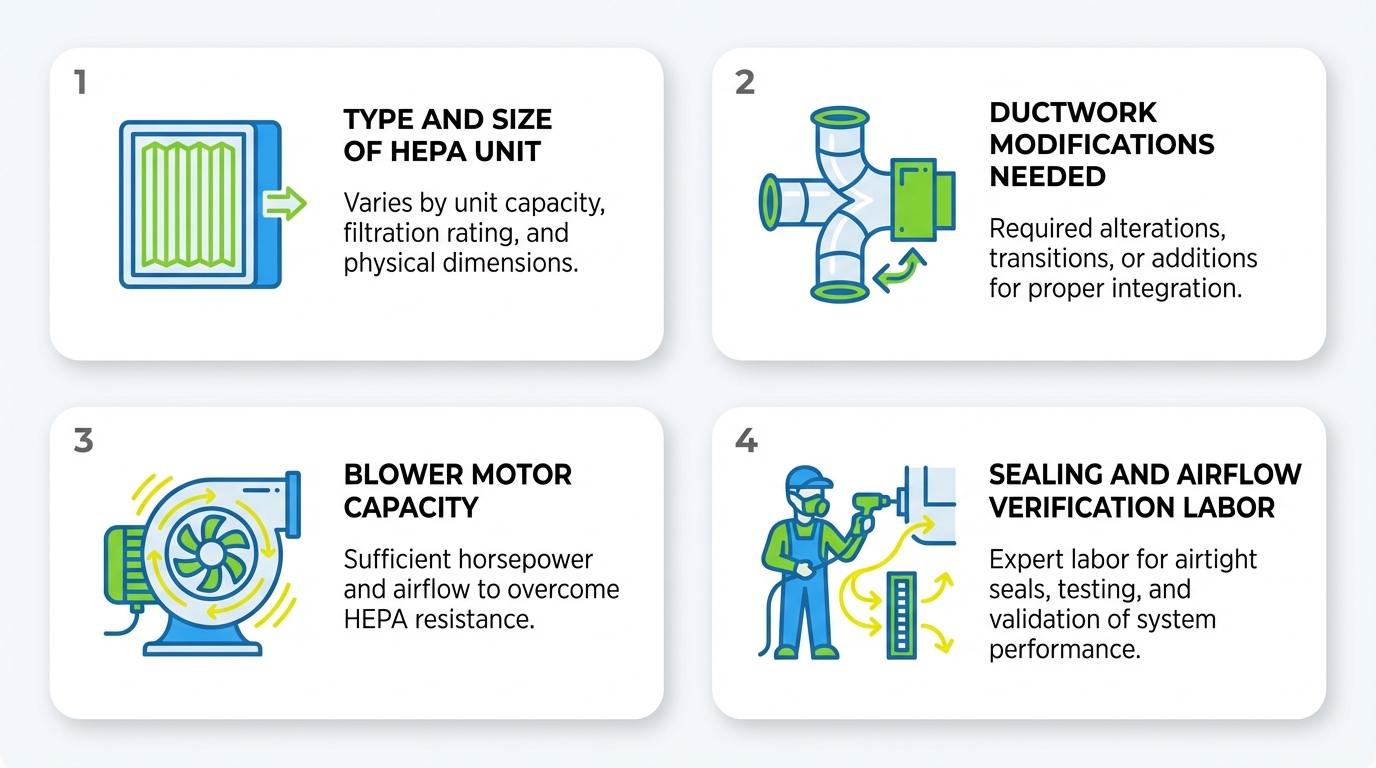
Pricing for HEPA filter installation varies widely because the scope of work differs from one property to the next. A straightforward bypass unit on a single residential system is a very different project from retrofitting a multi-zone commercial HVAC with dedicated filtration housings. The primary cost factors include:
The type and size of the HEPA unit, whether ductwork modifications or a new filter housing are needed, whether the blower motor can handle the additional resistance or requires an upgrade, and the labor involved in ensuring proper sealing and airflow verification.
Flat-rate pricing with no hidden fees is one of the practical advantages that Clean Air Houston Pro offers. You receive a detailed estimate that covers equipment, labor, and post-installation testing before any work begins. This transparency helps you compare the investment against the long-term benefits: reduced system strain, lower risk of costly HVAC repairs from operating against excessive static pressure, and improved indoor air quality that occupants can actually feel.
A Practical Checklist Before You Schedule Installation
Before committing to a HEPA upgrade, it helps to gather some basic information about your property and current system. Knowing the age and model of your HVAC equipment, the current filter size and type, whether you have had duct cleaning performed recently, and what specific air quality concerns are driving the decision will all help the technician provide an accurate assessment.
If you have noticed any of the warning signs mentioned earlier — persistent dust, occupant complaints, uneven airflow — note those as well so they can be evaluated during the inspection.
Properties that have not had duct cleaning in several years should consider addressing that first. Installing a high efficiency filter on a duct system loaded with years of accumulated debris limits the filter’s effectiveness and can push contaminants further into the system during initial operation.
How Clean Air Houston Pro Approaches Filtration Projects Differently
The difference between a filter swap and a professional filtration installation comes down to process. Clean Air Houston Pro starts with an on-site evaluation that includes static pressure measurement, ductwork inspection, and a conversation about your specific goals. The recommendation is based on what the system can support and what will actually solve the problem — not on selling the most expensive unit available.
Every installation includes proper sealing to prevent bypass, post-installation airflow testing, and a clear maintenance plan so you know exactly when and how to keep the system performing. For commercial clients, the team coordinates scheduling to minimize disruption to business operations. For residential clients, the process is designed to be completed efficiently with transparent communication at every step.
This inspection-first, results-verified approach gives property owners confidence that the money spent on filtration is producing real, measurable improvement in indoor air quality.
Frequently Asked Questions
+
+
+
+
+
+
Every HVAC system is different. Rather than guessing which filter to buy online, let an experienced technician assess your system, measure your airflow, and provide a straightforward recommendation with transparent pricing.
Flat Rates | No Hidden Fees | Same-Day Service Available

