
Reading Time: 5 minutes
Air Quality Testing Houston TX: What Every Homeowner and Business Owner Needs to Know
- Houston consistently ranks among the worst U.S. cities for ozone and particle pollution, making indoor air quality testing essential for homes and businesses alike.
- A professional IAQ inspection goes beyond simple readings — it identifies the root cause of air quality problems by evaluating HVAC systems, moisture levels, and building conditions.
- DIY air monitors provide limited, often unreliable data compared to calibrated professional instruments backed by laboratory analysis.
- Texas requires separate licenses for mold assessment and remediation, and new 2025 regulations tighten these requirements further.
- Clean Air Houston Pro uses an inspection-first approach with flat-rate pricing, ensuring you understand the problem before any corrective work begins.
+
- Why Houston’s Environment Makes Indoor Air Quality Testing Critical
- Red Flags That Signal You Need a Professional Air Quality Test
- A Real-World Scenario That Happens More Often Than You Think
- What Does a Comprehensive IAQ Inspection Actually Include?
- IAQ Inspection vs. Basic Air Quality Test: Understanding the Difference
- Common Mistake: Ordering the Wrong Type of Test
- Measuring Modern Pollutants: VOCs, Radon, and Particulates
- Should You Test Air Quality After Water Damage or Flooding?
- Texas Regulations You Should Know Before Hiring a Testing Provider
- Comparing DIY Air Monitors vs. Professional Air Quality Testing
- What Factors Influence the Cost of Air Quality Testing in Houston?
- How Long Does an IAQ Inspection Take and When Do You Get Results?
- How Clean Air Houston Pro Supports Better Indoor Air Quality
- Frequently Asked Questions
Houston’s climate brings unique indoor air quality challenges that most property owners do not think about until something feels off. Between the region’s persistent humidity, proximity to industrial corridors, and year-round reliance on air conditioning, the air circulating inside Houston homes and commercial buildings can carry a surprising mix of pollutants. According to the Houston Chronicle, the Houston metro area consistently ranks among the worst in the United States for ozone and particle pollution. That outdoor reality directly influences what happens inside your property — especially when ductwork, ventilation systems, and building materials trap and recirculate contaminants.
Air quality testing in Houston TX is not just a precaution. It is a practical step toward understanding what you and your occupants are breathing every day. Whether you manage a commercial office, run a retail store, or simply want answers about persistent dust or odors at home, a professional indoor air assessment provides the data you need to make informed decisions. And because pollutants move through HVAC systems, scheduling professional air duct cleaning is often a logical companion step once testing reveals what is circulating through your ducts.
Why Houston’s Environment Makes Indoor Air Quality Testing Critical
Many people assume that closing windows and running the AC keeps outdoor pollution out. In reality, Houston’s outdoor air quality issues — ozone spikes, particulate matter from traffic and refineries — infiltrate buildings through ventilation intakes, gaps in the building envelope, and every time a door opens. Axios Houston has reported the city regularly makes the top 10 for least healthy air quality, primarily due to ozone levels.
Once inside, those outdoor pollutants mix with indoor sources: dust from aging insulation, volatile chemicals off-gassing from new flooring or paint, moisture-driven biological growth, and the everyday accumulation of allergens. Houston’s subtropical humidity accelerates these problems. Without testing, you are essentially guessing whether your indoor environment is healthy or slowly degrading air quality for everyone inside.
Red Flags That Signal You Need a Professional Air Quality Test
Physical symptoms are often the first clue. According to OSHA, common IAQ-related complaints include headaches, fatigue, difficulty concentrating, and irritation of the eyes, nose, or throat. If these symptoms improve when occupants leave the building and return when they come back, the building itself may be contributing to the problem.
Environmental triggers deserve equal attention. Recent remodeling introduces dust and chemical off-gassing. Water damage or flooding — even a small leak left unaddressed — can create conditions for mold growth and elevated moisture levels. Persistent musty or chemical odors that cleaning does not resolve often point to a source hidden inside walls, ductwork, or crawl spaces. Any of these scenarios warrants professional pollution testing to identify what is actually in the air rather than relying on assumptions.
“They did a fantastic job. The Houston allergens and poor air quality in my home were problematic. Scheduling was easy, and the team was professional and thorough.”
A Real-World Scenario That Happens More Often Than You Think
A Houston office manager notices that employees on one floor complain about headaches every afternoon, but the other floor seems fine. Maintenance checks the thermostat and replaces a filter. Complaints continue. A professional IAQ inspection reveals that the return air plenum on the affected floor has a moisture problem from a slow condensate drain leak. Elevated humidity in that section has created conditions favorable for biological growth, and CO2 levels are consistently above comfortable thresholds because the ventilation damper is partially stuck. Without testing, the real cause would have remained hidden behind a fresh filter.
This kind of targeted investigation is exactly what separates a proper indoor air assessment from guesswork. It is also why Clean Air Houston Pro takes an inspection-first approach — identifying the actual source before recommending any corrective action.
Flat Rates | No Hidden Fees | Same-Day Service Available
What Does a Comprehensive IAQ Inspection Actually Include?
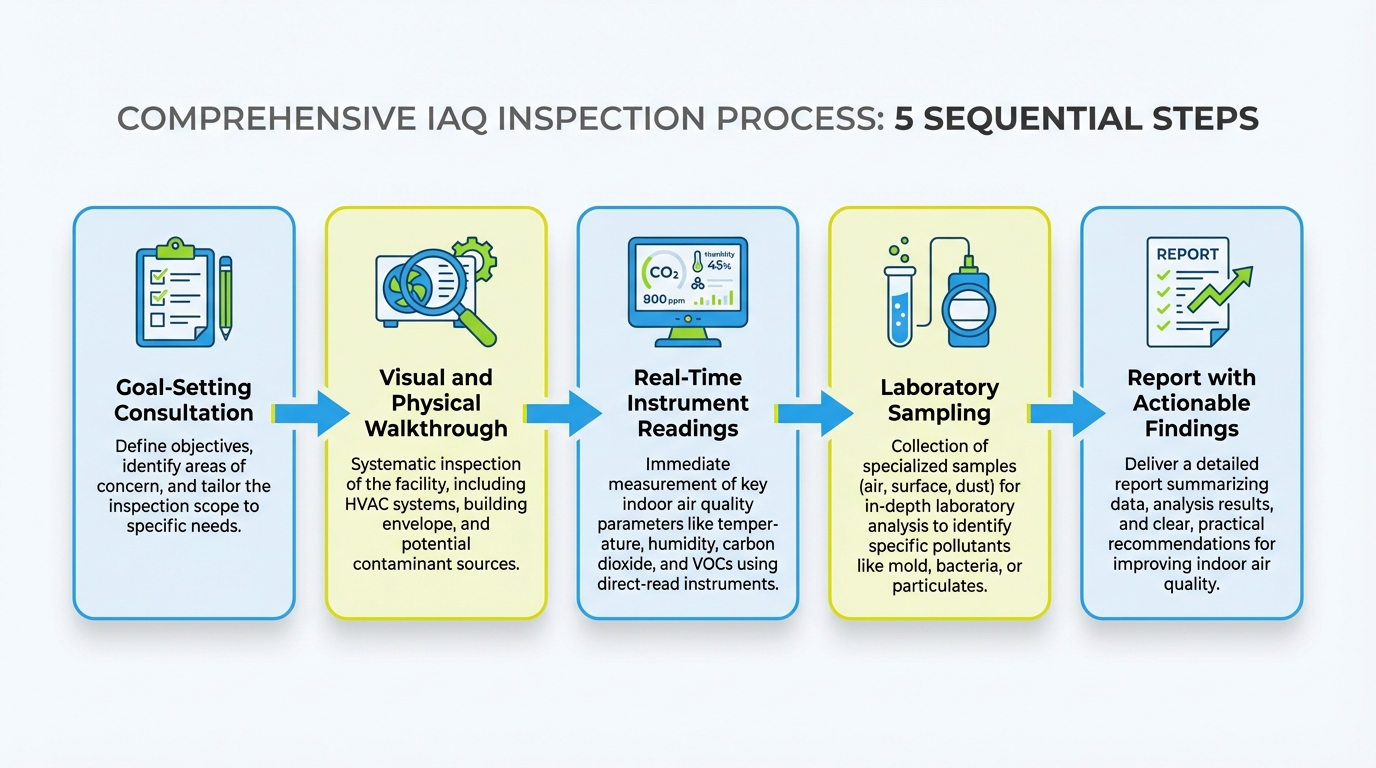
A professional IAQ inspection follows a structured process designed to gather meaningful data rather than random readings. Here is what a thorough assessment typically involves, step by step.
From Pre-Assessment to Final Report
The process begins with a conversation about the reason for testing: occupant complaints, post-renovation concerns, water damage history, or routine due diligence. This determines which parameters to measure and where to sample. Next comes the on-site walkthrough — a visual assessment of the building, HVAC components, ventilation pathways, moisture-prone areas, and potential contamination sources. Technicians then deploy instruments and sampling equipment tailored to the situation: direct-read monitors for CO2, CO, temperature, humidity, and particulates, plus collection media for laboratory analysis when biologicals or specific chemicals are suspected.
The EPA recommends comparing indoor CO2 levels against outdoor levels as a practical screening indicator of ventilation adequacy. If indoor CO2 is significantly higher, the building is likely under-ventilated — a common root cause of “stuffy” air complaints. The CDC’s Dampness and Mold Assessment Tool (DMAT) provides a standardized framework for evaluating moisture-related health risks in buildings, and reputable inspectors incorporate similar systematic approaches.
When elevated mold levels are detected, a professional assessment may recommend licensed mold remediation as the appropriate next step rather than surface-level cleaning that fails to address the source.
| Inspection Step | What Happens | Why It Matters |
|---|---|---|
| Goal-Setting Consultation | Discuss complaints, history, and objectives | Ensures the right parameters are tested |
| Visual and Physical Walkthrough | Check HVAC, moisture signs, ventilation paths | Identifies potential contamination sources |
| Real-Time Instrument Readings | Measure CO2, CO, humidity, temperature, PM | Provides immediate environmental snapshot |
| Laboratory Sampling (if needed) | Collect air or surface samples for analysis | Confirms or rules out specific contaminants |
| Report with Actionable Findings | Executive summary, data, and recommendations | Translates numbers into practical next steps |
IAQ Inspection vs. Basic Air Quality Test: Understanding the Difference
These terms are sometimes used interchangeably, but they represent different levels of investigation. An air quality test typically means collecting measurements or samples at specific points — it answers “what is in the air right now.” An IAQ inspection goes further: it combines those measurements with a physical evaluation of the building, its systems, and its history to answer “why the air quality is what it is and what to do about it.” An indoor air assessment is a broader term that can encompass both, depending on the scope defined at the outset.
For businesses, the distinction matters because a standalone test result without context can be misleading. Elevated particulate readings, for example, could stem from a construction project next door, a failing filter, or deteriorating insulation. Only a full inspection connects the data to the cause.
Common Mistake: Ordering the Wrong Type of Test
One of the most frequent errors property owners make is requesting a narrow test when a broader assessment is needed — or paying for extensive lab work when a screening-level inspection would have answered the question. Ordering a “mold test” when the actual issue is chemical off-gassing from a recent renovation wastes money and delays resolution. Conversely, skipping laboratory confirmation when there is visible water damage and occupant health complaints can leave you without the documentation needed for insurance or regulatory purposes.
A practical first step is to describe the problem to the inspector in detail — what you see, what you smell, when it started, and who is affected — so the scope of work can be tailored appropriately. Clean Air Houston Pro helps clients define the right scope before any equipment is deployed, which avoids unnecessary costs and ensures results are actually useful.
“Stacy’s team was awesome fast and professional! They explained everything to me before they did anything. Very fair pricing. I will definitely use them again.”
Measuring Modern Pollutants: VOCs, Radon, and Particulates in Houston Properties
Not all pollutants behave the same way, and not all tests detect the same things. Understanding the major categories helps you ask better questions when hiring a testing provider.
Volatile Organic Compounds (VOCs)
VOCs are gases released by a wide range of products: paints, adhesives, solvents, cleaning agents, new furniture, and even some building materials. The EPA notes that VOC concentrations indoors can be two to five times higher than outdoors, with health effects ranging from eye and throat irritation to headaches and nausea. In Houston, where buildings are sealed tightly against heat and humidity, VOCs can accumulate quickly after renovation or when new materials are introduced.
Radon
Radon is a naturally occurring radioactive gas that seeps from the ground into buildings through foundation cracks and openings. While Houston is not typically classified as a “high-risk” radon zone, the EPA emphasizes that any building can have elevated levels. The EPA’s action level is 4 pCi/L — if testing reveals concentrations at or above that threshold, mitigation is recommended. The Texas Railroad Commission references the same standard in its regulatory guidance.
Particulate Matter (PM)
Particulate matter includes dust, pollen, combustion byproducts, and fibers. In commercial settings, PM levels can spike from HVAC issues, nearby construction, or deteriorating materials. Accurate particulate measurement requires calibrated instruments and proper placement — another reason professional testing outperforms consumer-grade monitors for actionable data.
Our inspection-first approach identifies exactly what is in your air — and what to do about it. No guesswork, no unnecessary upselling.
Schedule Your Air Quality Assessment
Or call us: (832) 737-8500
Should You Test Air Quality After Water Damage or Flooding?
In almost every case, yes. Water damage that goes unaddressed for more than 24 to 48 hours creates conditions favorable for mold and bacterial growth. Houston’s humidity makes this timeline even more critical because ambient moisture slows natural drying. A professional assessment after water intrusion should include moisture mapping of affected materials, humidity measurements in the air and within wall cavities, and an evaluation of whether HVAC components were compromised.
It is worth noting that the CDC states routine air sampling for mold is generally not recommended as a first step. A visual inspection and moisture assessment often provide more reliable information about whether remediation is needed. Air sampling becomes valuable when the extent of contamination is unclear, when occupants report health symptoms, or when documentation is required for insurance or legal purposes.
Texas Regulations You Should Know Before Hiring a Testing Provider
Texas takes mold-related work seriously from a licensing perspective. The Texas Department of Licensing and Regulation (TDLR) requires mold assessors and mold remediators to hold separate licenses, and the Texas Attorney General’s office warns consumers about the conflict of interest that arises when the same company performs both testing and remediation. Starting September 1, 2025, a new Texas law repeals the previous exemption that allowed certain unlicensed individuals to conduct mold assessments under supervision — making proper licensing even more important when selecting a provider.
For commercial buildings, credible IAQ work should reference recognized ventilation standards such as ANSI/ASHRAE Standard 62.1, which establishes minimum ventilation rates and IAQ requirements for non-residential buildings. When your testing provider understands and applies these standards, the resulting report carries more weight — whether it is used for internal decision-making, tenant communication, or regulatory compliance.
Poor insulation or aging attic materials can also influence test results by introducing particulate matter or reducing the building envelope’s ability to control moisture. If your property has older insulation, consider evaluating it alongside your air quality assessment. Clean Air Houston Pro offers attic insulation services that can address these contributing factors.
Comparing DIY Air Monitors vs. Professional Air Quality Testing
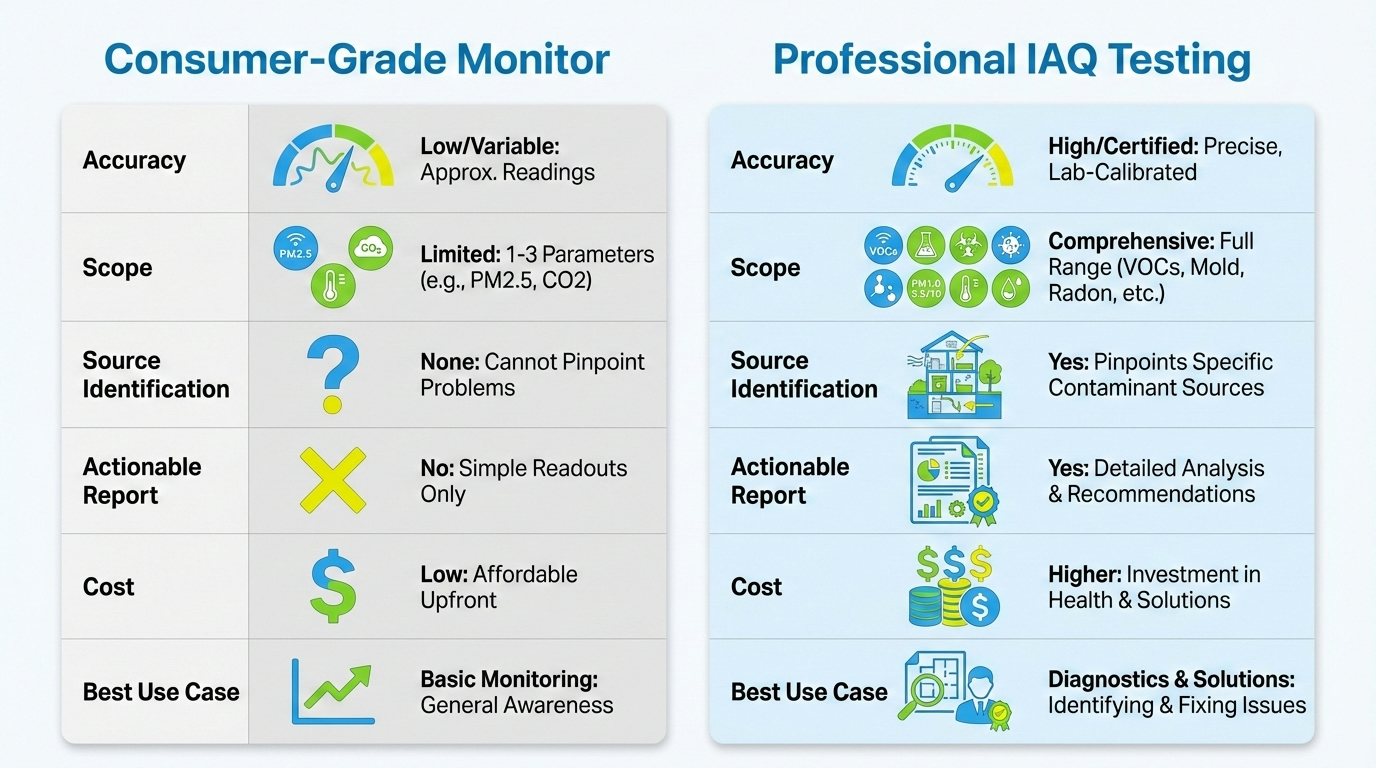
| Factor | Consumer-Grade Monitor | Professional IAQ Testing |
|---|---|---|
| Accuracy | Variable; sensors drift over time | Calibrated instruments; lab-verified results |
| Scope | Usually 1-3 parameters (CO2, PM, temp) | Full range: gases, biologicals, particulates, moisture |
| Source Identification | Shows readings, not root cause | Connects data to building conditions and HVAC |
| Actionable Report | No professional documentation | Written report with findings and recommendations |
| Cost | Lower upfront; limited value | Higher upfront; resolves the actual problem |
| Best Use Case | Ongoing trend monitoring after professional baseline | Initial assessment, post-event investigation, compliance |
Consumer monitors can be useful for ongoing awareness — tracking humidity trends or watching CO2 levels in a conference room, for example. But they are not a substitute for a professional assessment when you need to identify a specific problem, document conditions for a third party, or make decisions about remediation. Think of a consumer monitor as a thermometer and a professional inspection as a full medical exam.
“Very responsive and professional. They got me on their schedule day after I called. The technicians were knowledgeable and took time to explain everything.”
What Factors Influence the Cost of Air Quality Testing in Houston?
Pricing for air quality testing in Houston TX depends on several variables, and understanding them helps you evaluate quotes accurately. The primary factors include the size of the property and number of distinct zones to be tested, the types of parameters being measured, whether laboratory analysis is required, and the level of reporting detail needed.
A screening-level walkthrough with real-time instrument readings for a small office will cost significantly less than a multi-floor commercial assessment with laboratory samples for mold, VOCs, and particulates. Urgency matters too — emergency post-flood assessments may carry premium scheduling rates. The key is to ask what is included in the quote: how many sampling locations, which parameters, what format the report takes, and whether a follow-up visit for verification is part of the scope.
Clean Air Houston Pro provides flat-rate pricing with no hidden fees, so you know what you are paying for before the work begins. That transparency extends to clearly defining the scope of testing during the initial consultation, which prevents surprise charges and ensures the assessment matches your actual needs.
How Long Does an IAQ Inspection Take and When Do You Get Results?
For most residential properties, an on-site inspection takes one to three hours depending on the size and complexity of the home. Commercial properties with multiple floors or specialized spaces may require a half day or longer. Real-time measurements — CO2, CO, humidity, temperature, particulate counts — are available immediately during the visit. If laboratory samples are collected (air cassettes, swabs, or bulk material), results typically take three to seven business days depending on the lab and the analyses requested.
Setting clear expectations about timelines upfront prevents frustration. A good provider will tell you exactly which results come same-day and which require laboratory turnaround, so you can plan any corrective actions accordingly.
Flat Rates | No Hidden Fees | Same-Day Service Available
How Clean Air Houston Pro Supports Better Indoor Air Quality
| Your Need | How Clean Air Houston Pro Helps |
|---|---|
| Persistent dust or allergens circulating through your space | Thorough air duct cleaning using HEPA-filtered, negative-pressure equipment to remove buildup from the entire system |
| Post-water-damage concerns about mold or moisture | Professional assessment and licensed mold remediation with documentation for your records |
| Energy efficiency and airflow issues tied to insulation | Attic insulation evaluation and installation to improve building envelope performance |
| Transparent pricing without surprise add-ons | Flat-rate quotes defined before work begins, with scope clearly outlined |
| Wanting to understand what you are breathing before and after service | Inspection-first approach that identifies the problem before recommending solutions |
Frequently Asked Questions About Air Quality Testing in Houston
+
+
+
+
+
Ready to Find Out What Is in Your Indoor Air?
If your Houston home or business has unexplained odors, occupant complaints, recent water damage, or you simply want a professional baseline of what you are breathing, the most practical next step is a conversation with a qualified team. Clean Air Houston Pro’s inspection-first approach means you get honest answers and a clear scope before any work begins — no pressure, no unnecessary upselling, just data-driven guidance tailored to your property.
Schedule your professional indoor air quality assessment with Clean Air Houston Pro today. Honest answers. Clear pricing. Real results.
Flat Rates | No Hidden Fees | Same-Day Service Available

