
Reading Time: 5 minutes
Humidity Control Houston: Moisture Control, Dehumidifier Installation and Long-Term Dampness Solutions
- Houston’s subtropical climate regularly pushes indoor humidity above 60%, creating ideal conditions for mold growth, structural damage, and respiratory issues
- Your AC alone cannot adequately control moisture — oversized units, short-cycling, and transitional seasons leave indoor air dangerously humid
- The EPA recommends keeping indoor relative humidity between 30% and 50% to protect health, furnishings, and building materials
- Professionally installed whole-building dehumidifiers outperform portable units in coverage, reliability, and long-term cost efficiency
- A comprehensive dampness solution starts with fixing the building envelope before sizing dehumidification equipment
+
- What Does Humidity Control Actually Mean for a Houston Property?
- Why Is My Indoor Humidity Still High When the AC Runs All Day?
- When Does a Property Need a Dedicated Dehumidifier?
- Portable Dehumidifier vs. Professionally Installed System
- How Excess Moisture Damages Health in Houston
- Texas Mold Regulations and Prevention
- What Factors Drive the Cost of Humidity Control?
- How Long Does Dehumidifier Installation Take?
- Best Location for Dehumidification System Installation
- Integrating Humidity Control with Your HVAC System
- Avoiding the Building Envelope Mistake
- What Humidity Level Prevents Mold in Commercial Buildings?
- Checking System Performance Over Time
- Frequently Asked Questions
Houston’s subtropical climate creates one of the toughest indoor moisture challenges in the country. With average outdoor relative humidity often exceeding 80 percent during summer mornings, the air inside homes, offices, warehouses, and retail spaces can feel sticky and uncomfortable — even when the air conditioning is running full blast. Effective humidity control Houston residents and property managers can rely on goes far beyond turning the thermostat down. It requires understanding how moisture behaves inside a building, identifying weak points in the HVAC system and building envelope, and choosing the right combination of equipment, maintenance, and professional support.
The U.S. EPA recommends keeping indoor humidity between 30 and 50 percent to minimize mold risk and protect building materials. This guide from Clean Air Houston Pro walks you through every practical question — from recognizing warning signs to professional dehumidifier installation and ongoing dampness solution strategies.
What Does Humidity Control Actually Mean for a Houston Property?
Humidity control is the deliberate, ongoing management of water vapor inside a building. In a humid coastal city like Houston, TX, indoor moisture levels can climb well above the comfort zone even when doors and windows stay shut. The goal is not to eliminate moisture entirely — extremely dry air creates its own problems — but to keep relative humidity (RH) within a range that protects occupants, furnishings, equipment, and the structure itself. For most residential and commercial spaces, that target falls between 30 and 50 percent RH. Anything consistently above 55 to 60 percent starts fueling biological growth, corrosion, and odors.
In commercial properties, uncontrolled humidity shows up as employee complaints about “clammy” air, condensation dripping onto inventory, fogged storefront windows, and musty smells that drive customers away. A comprehensive dampness solution addresses every moisture pathway — not just the thermostat setting.
Why Is My Indoor Humidity Still High When the AC Runs All Day?
This is arguably the most common frustration Houston homeowners and facility managers share. The short answer: cooling and dehumidifying are related but not identical processes. An air conditioning system removes some moisture as a byproduct of cooling, but several common scenarios prevent it from removing enough.
An oversized AC unit is one of the biggest culprits. When the system has more cooling capacity than the space requires, it reaches the target temperature quickly, shuts off, and never runs long enough to pull significant moisture from the air. This short-cycling effect has been well documented — oversized equipment often leaves occupants feeling uncomfortable despite adequate temperature control. Other factors include clogged filters that restrict airflow across the evaporator coil, a blower speed set too high for the latent load, and clogged condensate drains that allow moisture to re-evaporate into the ductwork.
Clues That the Problem Is Operational, Not Just Weather
If you notice condensation forming on interior windows, water stains near supply registers, a persistent musty odor even after cleaning, or a hygrometer reading above 60 percent RH while the AC cycles on and off frequently — the issue is likely mechanical or design-related. These signs point toward the need for a professional inspection of the HVAC system and possibly a dedicated humidity reduction strategy rather than simply lowering the thermostat further.
“They did a fantastic job. The Houston allergens and poor air quality in my home were problematic. Scheduling was easy, and the team was professional and thorough.”
When Does a Property Need a Dedicated Dehumidifier Instead of HVAC Adjustments?
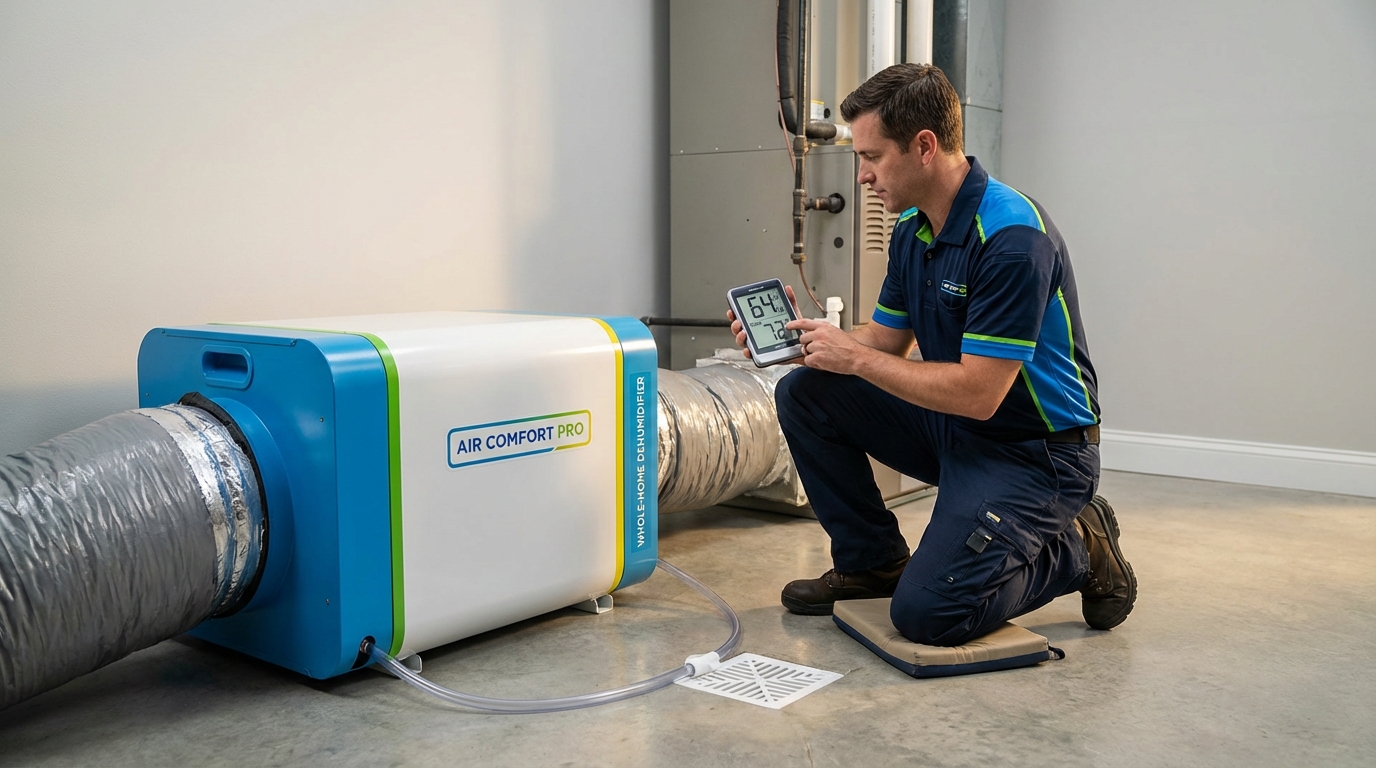
Sometimes recalibrating the existing system is enough: slowing the fan speed, fixing duct leaks, or correcting refrigerant charge can improve moisture removal noticeably. But there are clear situations where adjustments alone will not solve the problem. If RH consistently stays above 60 percent after HVAC optimization, or if the building has high fresh-air loads — frequent door openings, commercial kitchen exhaust, or code-mandated ventilation rates — a standalone or ducted dehumidifier becomes necessary.
Transitional months in Houston (late spring, early fall) present a particular challenge. Outdoor temperatures may not be high enough to trigger sustained cooling cycles, yet outdoor humidity remains extreme. During these windows, the AC barely runs, and indoor moisture climbs unchecked. A dedicated dehumidifier installation fills that gap by operating independently of the cooling call, targeting humidity rather than temperature.
Get a professional humidity and airflow assessment with flat-rate pricing — no hidden fees, no pressure. Find out exactly what is driving your moisture problems.
Or call us: (832) 737-8500
Portable Dehumidifier vs. Professionally Installed System — What Is the Real Difference?
| Factor | Portable Unit | Professionally Installed System |
|---|---|---|
| Coverage area | Single room or small zone | Whole building or large zone via ductwork |
| Water removal capacity | Typically 30-70 pints per day | 90-150+ pints per day (commercial models higher) |
| Drainage | Manual bucket emptying or gravity hose | Plumbed condensate line or pump to drain |
| Noise and placement | Visible in occupied space, audible | Tucked in mechanical room, attic, or ceiling plenum |
| Control integration | Standalone humidistat on the unit | Tied to building automation or thermostat with remote sensors |
| Maintenance | Frequent filter cleaning, bucket monitoring | Scheduled service visits, typically annual |
| Long-term reliability | Consumer-grade components | Commercial-grade compressor and coils rated for continuous duty |
For a single closet or seasonal guest room, a portable unit may suffice. For consistent moisture control across an entire home, office suite, or warehouse, a professionally installed system is the practical choice. Clean Air Houston Pro evaluates the building envelope, duct layout, and occupancy patterns before recommending equipment size — this inspection-first approach helps avoid the common mistake of installing a unit that is too small to keep up or too large for efficient cycling.
How Does Excess Moisture Damage Health — and Why Should Houston Property Owners Care?
Research published by the CDC’s National Institute for Occupational Safety and Health (NIOSH) links building dampness to a range of respiratory problems, including worsened asthma symptoms, chronic cough, and upper-airway irritation. This applies to workplaces, schools, and residences alike. Children, elderly occupants, and anyone with pre-existing respiratory conditions tend to be most affected.
Beyond health, structural damage accumulates quietly. Wood framing softens and rots, drywall becomes a food source for mold colonies, wallpaper peels, and electronics suffer from corrosion on circuit boards. In a commercial context, damaged inventory — whether it is paper records, textiles, pharmaceuticals, or food products — can represent significant financial loss. Prevention through reliable humidity reduction is almost always less expensive than remediation after the fact.
What Are the Texas Regulations Around Mold — and How Does Prevention Fit In?
Texas requires mold assessors and mold remediators to hold licenses issued by the Texas Department of Licensing and Regulation (TDLR). According to TDLR guidance, keeping indoor humidity no higher than 50 percent is one of the primary preventive steps property owners can take. If mold does develop beyond a minor surface area, hiring licensed professionals for assessment and remediation is legally required in many circumstances.
The financial takeaway is straightforward: investing in ongoing moisture control — proper HVAC maintenance, dehumidification equipment, and building-envelope improvements — can help you avoid the much larger expense and disruption of a licensed remediation project. Clean Air Houston Pro supports this prevention-first mindset by offering transparent, flat-rate evaluations so property owners can understand their risk before problems escalate.
What Factors Drive the Cost of Humidity Control in Houston?
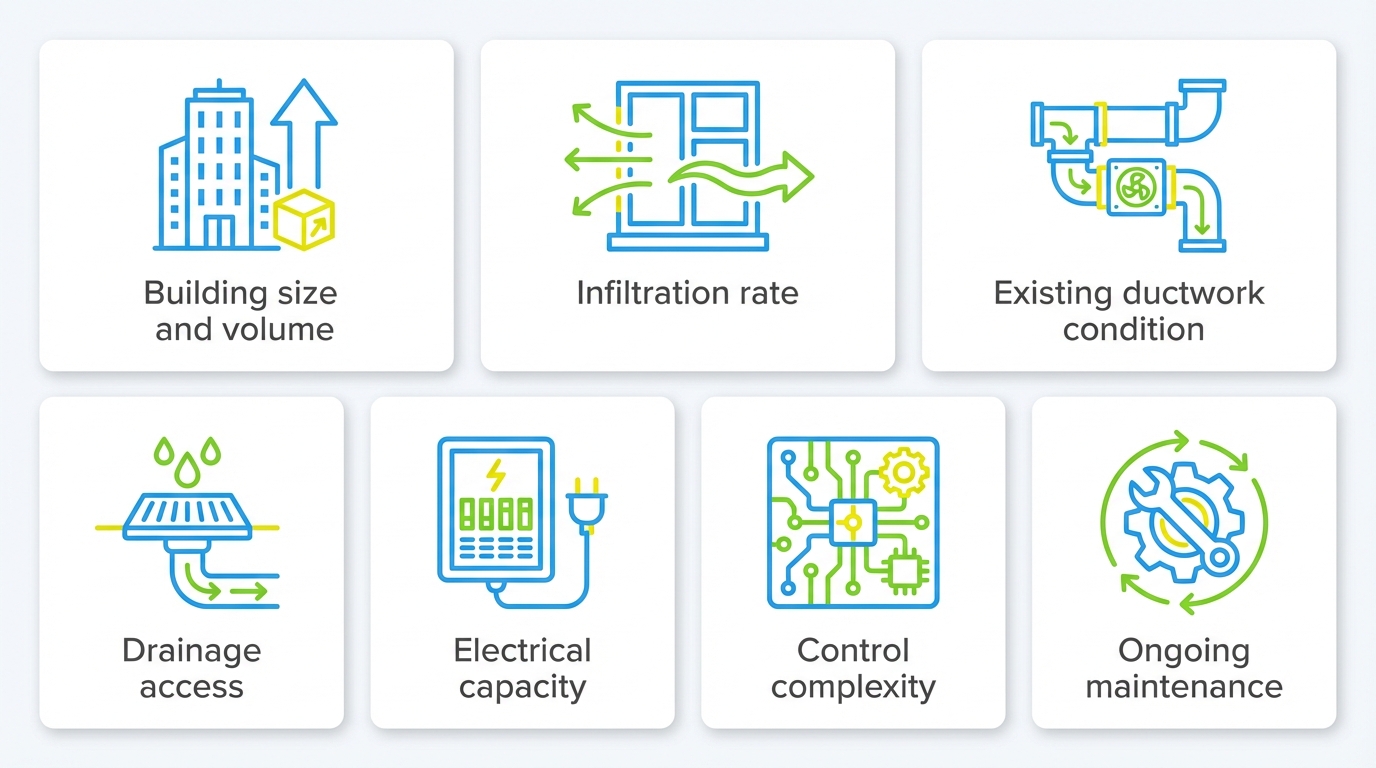
There is no single price tag because every building presents a different combination of variables. Understanding what influences cost helps you evaluate quotes more confidently and avoid surprises.
| Cost Factor | Why It Matters |
|---|---|
| Building size and volume | Larger spaces require higher-capacity equipment and potentially multiple units |
| Infiltration rate | Leaky envelopes or frequent door openings increase moisture load, demanding more powerful dehumidification |
| Existing ductwork condition | If ducts are leaking or undersized, modifications may be needed before installing a dehumidifier |
| Drainage access | A nearby floor drain keeps installation simple; a remote location may require a condensate pump and piping |
| Electrical capacity | Some older buildings need a dedicated circuit or panel upgrade |
| Control complexity | Basic humidistat vs. multi-zone sensors with building automation integration |
| Ongoing maintenance | Annual filter changes, coil cleaning, and drain line checks should be included in total cost of ownership |
Clean Air Houston Pro provides flat-rate evaluations with no hidden fees, so property owners receive a clear scope and price before any work begins. This transparency matters especially for commercial clients managing multiple properties across the Houston metro area.
“Stacy’s team was awesome fast and professional! They explained everything to me before they did anything. Very fair pricing. I will definitely use them again.”
Flat Rates | No Hidden Fees | Same-Day Service Available
How Long Does a Dehumidifier Installation Typically Take?
For a standard residential whole-home unit tied into existing ductwork with accessible drainage nearby, most installations are completed within a single work day — often in four to six hours. Commercial projects with custom ductwork, condensate pumps, electrical work, and multi-zone controls may take one to three days depending on scope. The key variable is preparation: if the site survey is thorough and materials are staged in advance, installation day runs smoothly with minimal disruption to building operations.
What Should You Verify at Handoff?
Before signing off on the completed installation, confirm that the unit reaches and maintains the target RH within a reasonable stabilization period. Check that the condensate drain flows freely, listen for unusual vibration or noise, verify sensor accuracy against a calibrated reference, and review the maintenance schedule with the installer. A reputable company will walk you through each checkpoint — not just hand you a manual and leave.
Where Is the Best Location to Install a Dehumidification System?
Placement matters as much as sizing. The ideal location provides easy access for filter changes and coil cleaning, proximity to a drain or sump for condensate, adequate clearance for airflow on the intake and discharge sides, and a connection path to the supply or return ductwork that does not create excessive static pressure. In residential homes, the attic, garage utility area, or a dedicated mechanical closet are common choices. In commercial buildings, a mechanical room, rooftop equipment platform, or ceiling plenum above a drop ceiling often works best.
Poorly placed equipment can create “humidity islands” — zones that remain damp because conditioned air does not circulate effectively to that area. This is where professional duct layout analysis proves its value, and where Clean Air Houston Pro’s inspection-first approach helps ensure the dehumidified air actually reaches every corner of the space.
Integrating Humidity Control with Your HVAC: Cooperation, Not Competition
A dehumidifier and an air conditioning system can work against each other if not coordinated. The AC cools air and removes some moisture; the dehumidifier adds a small amount of heat as a byproduct of its refrigeration cycle. Without proper integration, the dehumidifier may warm the space enough to trigger extra AC runtime, and the AC may cool aggressively enough to suppress the dehumidifier’s call.
The solution is control-level integration: a shared humidistat or building management system that prioritizes humidity removal when RH exceeds the setpoint and allows the AC to handle temperature independently. In many Houston installations, slowing the blower speed during high-humidity periods helps the evaporator coil extract more moisture per cycle. Pairing this with a dedicated dehumidifier on a separate control loop delivers stable, comfortable conditions without energy waste.
Mistake to Avoid: Treating Symptoms While Ignoring the Building Envelope
Installing a powerful dehumidifier without addressing the source of moisture ingress is like running a sump pump while leaving the garden hose on. Common envelope weaknesses in Houston properties include deteriorated door and window weatherstripping, unsealed penetrations for plumbing and electrical, missing or damaged vapor barriers in crawl spaces and attics, and poorly insulated ductwork running through unconditioned spaces. A thorough moisture control strategy always starts with reducing the load before sizing the equipment to handle what remains.
Attic insulation condition plays a significant role. Inadequate or compressed insulation allows conditioned air to escape and outdoor humidity to migrate inward. Clean Air Houston Pro assesses insulation as part of a broader indoor air quality evaluation — because dehumidification equipment works far more efficiently when the building envelope does its job first.
“Very responsive and professional. They got me on their schedule day after I called. The technicians were knowledgeable and took time to explain everything.”
What Humidity Level Actually Prevents Mold in Commercial Buildings?
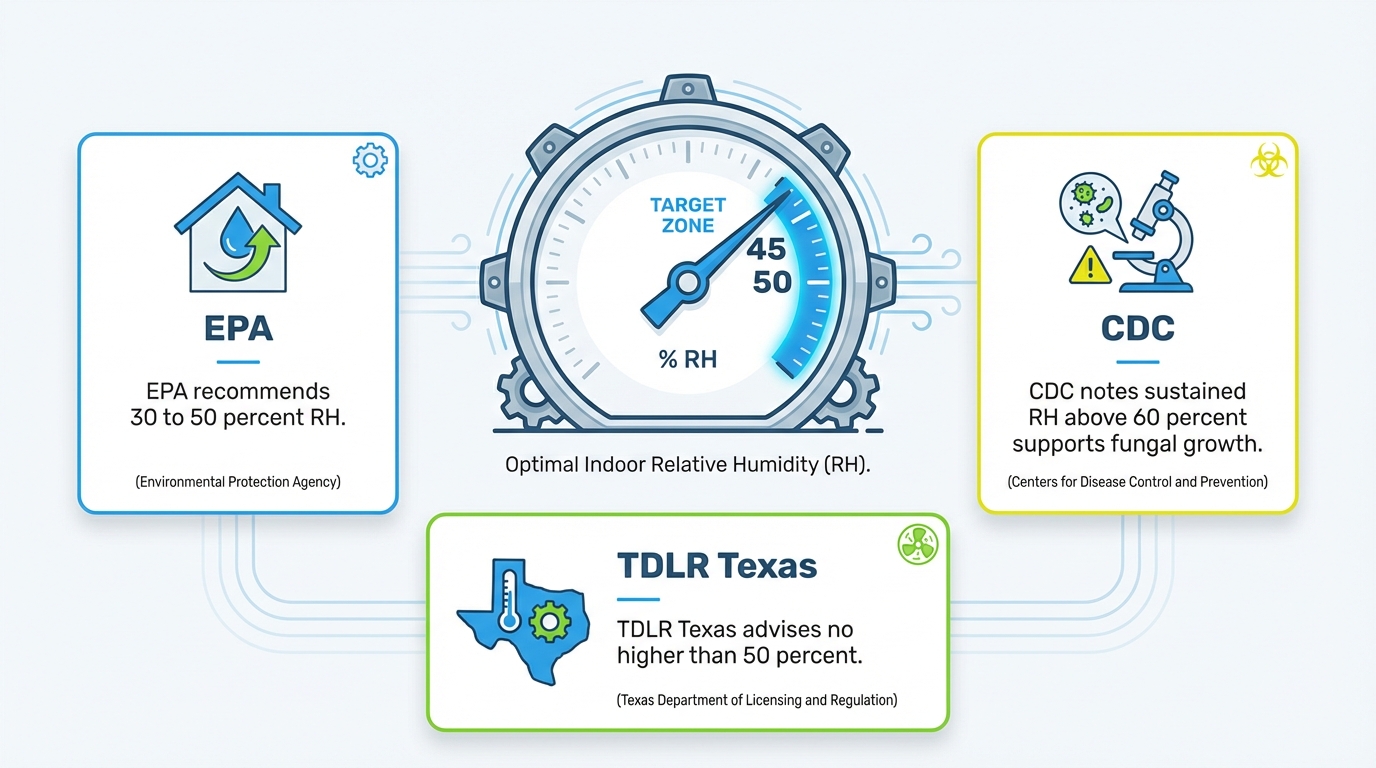
There is no magic number that guarantees zero mold risk, but regulatory and scientific guidance converges around a practical threshold. Here is what the authorities recommend:
| Source | Recommended Indoor RH |
|---|---|
| U.S. EPA | 30-50% (below 60% at minimum) |
| Texas TDLR | No higher than 50% for mold prevention |
| CDC/NIOSH | Below 60% to limit fungal growth in commercial environments |
| ASHRAE Standard 62.1 | Below 65% at cooling coil discharge |
For most Houston commercial properties, targeting 45 to 50 percent RH offers a realistic balance between energy cost and biological risk — especially in spaces with organic materials like paper, wood, or textiles.
Checking Performance: How Do You Know Your System Is Actually Working?
After installation, ongoing verification is essential. Place a calibrated digital hygrometer in the most challenging zone of the building — typically the area farthest from the dehumidifier or the zone with the highest moisture load. Log readings at peak and off-peak times for at least two weeks. If the system maintains the target range consistently, it is performing correctly. If you see RH climbing above 55 percent during specific periods, investigate whether it coincides with door openings, occupancy spikes, cooking, or HVAC schedule changes.
Annual professional maintenance — cleaning coils, checking refrigerant charge, flushing the drain line, and recalibrating sensors — keeps the system performing as designed. Skipping maintenance is one of the most common reasons a once-effective dampness solution gradually loses its effectiveness.
A Real-World Scenario: The Warehouse That “Sweats” Every Morning
Consider a 15,000-square-foot warehouse in the Houston Ship Channel area. Every morning the operations manager walks in to find water droplets on metal roof decking, damp cardboard boxes, and a foggy haze near the roll-up doors. The building has no dedicated climate control — just large exhaust fans and a few ceiling-mounted heaters for winter. Overnight, the metal roof cools below the dew point of the humid outdoor air that infiltrates through gaps, vents, and door seals. When warm, moisture-laden air contacts the cold metal, water condenses instantly.
The dampness solution here involves multiple layers: improving door seals and vapor barriers, insulating the underside of the roof deck, and installing a commercial dehumidifier sized for the space volume and infiltration rate. Simply adding exhaust fans can actually make the problem worse by pulling in more outdoor humidity. This is exactly the kind of layered analysis Clean Air Houston Pro provides during a comprehensive moisture assessment.
Frequently Asked Questions
+
+
+
+
+
+
If your home or commercial property feels clammy despite running the AC, shows signs of condensation, or has dealt with musty odors, the most practical next step is a professional humidity and airflow assessment.
Flat Rates | No Hidden Fees | Same-Day Service Available

