
Reading Time: 5 minutes
Radon Testing Houston TX: Why Every Home and Business Needs a Professional Radon Gas Test
- Radon is the second leading cause of lung cancer in the U.S. and cannot be detected without a proper radon gas test
- Houston homes built on slab-on-grade foundations are not immune to radon entry through cracks, joints, and plumbing penetrations
- The EPA action level is 4.0 pCi/L, but there is no known safe level of radon exposure, and levels between 2-4 pCi/L still warrant attention
- Professional continuous radon monitor (CRM) testing provides hourly data logs, tamper detection, and documentation that DIY kits cannot match
- Clean Air Houston Pro offers professional radon testing Houston TX with flat-rate pricing, detailed reporting, and same-day scheduling availability
+
- Why Houston Homeowners Cannot Ignore Radon
- Does Houston Really Have a Radon Problem?
- What Happens During a Professional Radon Gas Test
- How Radon Enters Houston Buildings Through Soil and Foundation
- Correct Radon Detector Placement for Accurate Readings
- Common Mistakes That Produce Unreliable Results
- What Radon Level Is Considered Dangerous
- Professional Radon Inspection vs. DIY Home Test Kits
- Is a 48-Hour Radon Test Accurate Enough
- What to Do When Radon Levels Come Back High
- How Radon Mitigation and Radon Removal Work
- Commercial Radon Testing for Schools, Offices, and Multi-Family Buildings
- What a Reliable Radon Test Report Should Include
- Frequently Asked Questions
Why Houston Homeowners Cannot Ignore Radon
Radon is a colorless, odorless, radioactive gas that forms naturally as uranium in soil and rock breaks down. It seeps upward through the ground and can accumulate inside any enclosed structure — houses, offices, schools, and warehouses alike. Many Houston homeowners assume radon is only a concern in northern states with deep basements, but that assumption can be dangerous. According to the CDC, radon is the second leading cause of lung cancer in the United States, responsible for an estimated 21,000 deaths each year. The only way to know whether your Houston property has elevated radon levels is through a proper radon gas test.
Indoor air quality involves many factors. Homeowners often start with air duct cleaning in Houston to reduce dust, allergens, and debris circulating through the HVAC system. That is an important step — but radon is a completely different hazard. It cannot be filtered by a standard HVAC system, and it cannot be detected by sight or smell. Radon testing Houston TX is a specialized process that measures gas concentration over time, giving you clear data on whether action is needed.
Does Houston Really Have a Radon Problem if the Area Is Labeled “Low Risk”?
Zone maps published by federal and state agencies classify Harris County as a generally lower-risk area. That classification, however, reflects broad averages across large geographic zones. It does not predict what is happening inside a specific building on a specific lot. Radon levels are influenced by local soil composition, foundation type, cracks and gaps in the slab, plumbing penetrations, and even how tightly the building is sealed. Two houses on the same street can produce very different readings.
Data aggregated for Harris County confirms that some homes do exceed the EPA action level of 4.0 pCi/L, even though the county average appears low. A “low-risk” label simply means the statistical likelihood is smaller — it does not guarantee safety. The EPA recommends that every home be tested regardless of geographic zone, because building-specific conditions can concentrate radon in ways that regional data cannot predict.
“They did a fantastic job. The Houston allergens and poor air quality in my home were problematic. Scheduling was easy, and the team was professional and thorough.”
What Exactly Happens During a Professional Radon Gas Test
A radon gas test measures the concentration of radon in indoor air over a defined period. A detector is placed in the lowest livable level of the building — typically a ground-floor room that residents or workers occupy regularly. The device records radon levels continuously or passively, depending on the test type, and the results are reported in picocuries per liter (pCi/L).
Short-Term vs. Long-Term Testing
Short-term tests typically run for two to seven days. They provide a snapshot that is useful for real estate transactions or initial screening. Long-term tests run for 90 days or more and produce a seasonal average that better reflects year-round exposure. For most Houston homeowners scheduling radon testing Houston TX for the first time, a professional short-term test with a continuous monitor offers a reliable starting point. If results are borderline (between 2 and 4 pCi/L), a follow-up long-term test can clarify whether mitigation is warranted.
Professional radon testing gives you the clear data you need to protect your family. Same-day scheduling available with flat-rate pricing and no hidden fees.
Schedule Your Radon Test Today
Or call us: (832) 737-8500
How Radon Enters Houston Buildings Through Soil and Foundation
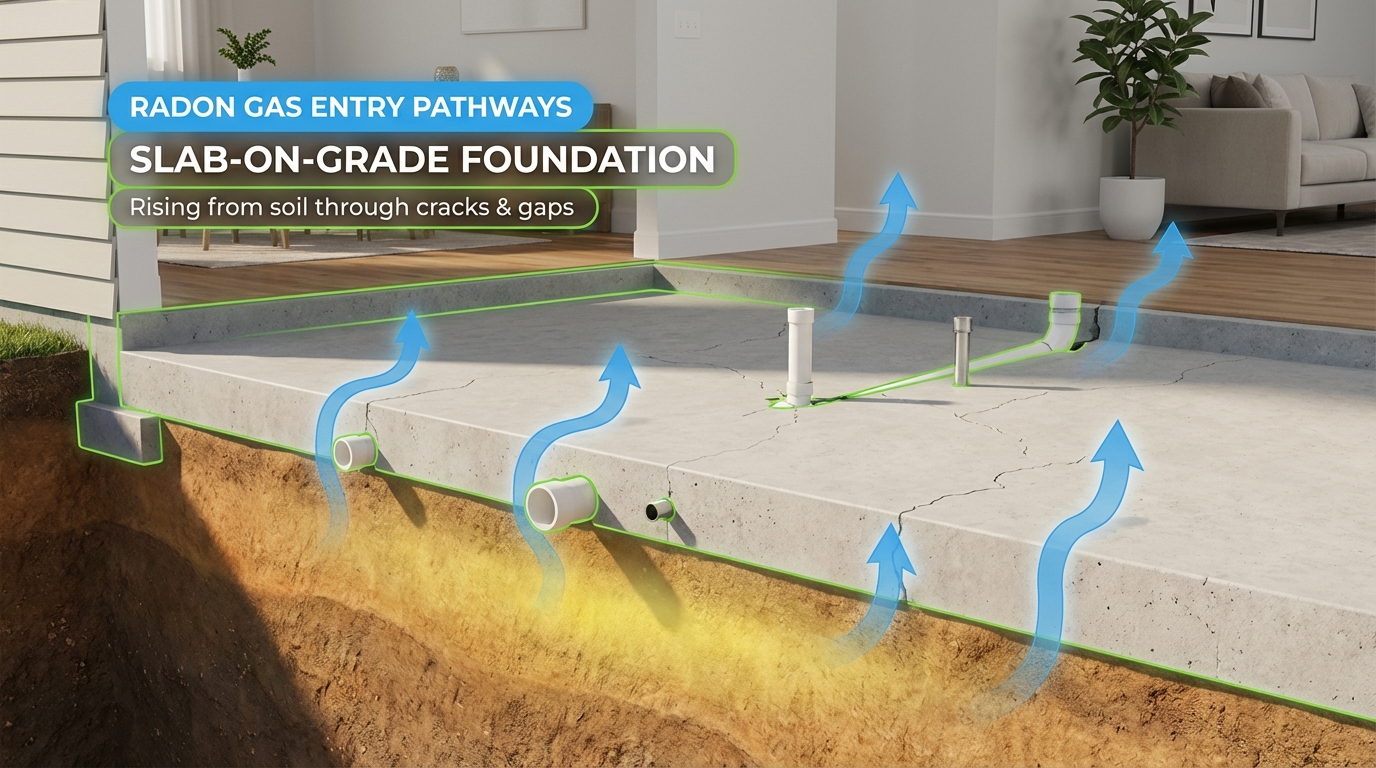
Radon moves from the soil into buildings through a process driven by pressure differentials. The air inside a building is typically at a slightly lower pressure than the soil gas beneath the foundation — a phenomenon sometimes called the “stack effect.” This pressure difference pulls soil gases, including radon, upward through any available pathway: cracks in the concrete slab, gaps around plumbing pipes, construction joints, sump pits, and even porous concrete itself.
Houston’s slab-on-grade construction is common, and many homeowners believe that a solid slab eliminates radon entry. In reality, even well-poured slabs develop micro-cracks over time as the expansive clay soils in the Houston metro area shift. Plumbing penetrations and utility conduits create additional pathways. Once radon enters the building envelope, it can accumulate — especially in tightly sealed, energy-efficient homes where natural air exchange is minimal.
This is one reason that improved insulation and air sealing, while excellent for energy savings, should always be paired with radon awareness. If you have recently upgraded your building envelope through attic insulation services, scheduling a radon test afterward is a practical safety step.
Where Should the Radon Detector Be Placed for an Accurate Reading?
Placement matters significantly. A detector positioned in the wrong location can produce a result that either underestimates or overestimates actual exposure. Professional protocols call for the device to be set in the lowest livable level of the building, at least 20 inches above the floor, and away from exterior walls, windows, doors, and HVAC supply vents. Kitchens and bathrooms are generally avoided because humidity and exhaust fans can interfere with readings.
In larger or multi-story commercial buildings, multiple sampling points may be needed to capture variations across different zones. A single measurement in a lobby does not tell you what is happening in a ground-floor classroom or a below-grade storage area. Professional radon inspection accounts for building layout and occupancy patterns to determine the right number and location of devices.
Common Mistakes That Produce Unreliable Radon Test Results
Homeowners who attempt testing without understanding the protocol often make errors that invalidate the data. Opening windows during the test period is one of the most frequent problems — it dilutes indoor radon and can make a dangerous level appear safe. Running exhaust fans, whole-house fans, or window-mounted air conditioners during the test creates the same issue. Placing the detector near a drafty door, in direct sunlight, or on the floor surface can also distort readings.
Another common mistake is failing to maintain closed-house conditions. The standard protocol requires that exterior windows and doors remain closed — except for normal entry and exit — beginning at least 12 hours before the test starts and continuing through the entire measurement period. HVAC systems can operate normally in recirculation mode, but settings that bring in large volumes of outside air should be adjusted during testing.
| Mistake | Why It Matters | How to Avoid It |
|---|---|---|
| Opening windows during test | Dilutes radon; result appears artificially low | Keep all exterior windows closed for 12+ hours before and during the test |
| Placing detector near exterior door | Draft introduces outside air, skewing the reading | Position at least several feet from any exterior opening |
| Running exhaust fans continuously | Pulls indoor air out, reduces measured concentration | Limit exhaust fan use to normal, brief operation |
| Setting device on the floor | Humidity and floor-level air patterns affect accuracy | Elevate the detector at least 20 inches above floor level |
| Testing for less than 48 hours | Insufficient data for a meaningful average | Run short-term tests for a minimum of 48 hours |
What Radon Level Is Considered Dangerous — and When Should You Take Action?
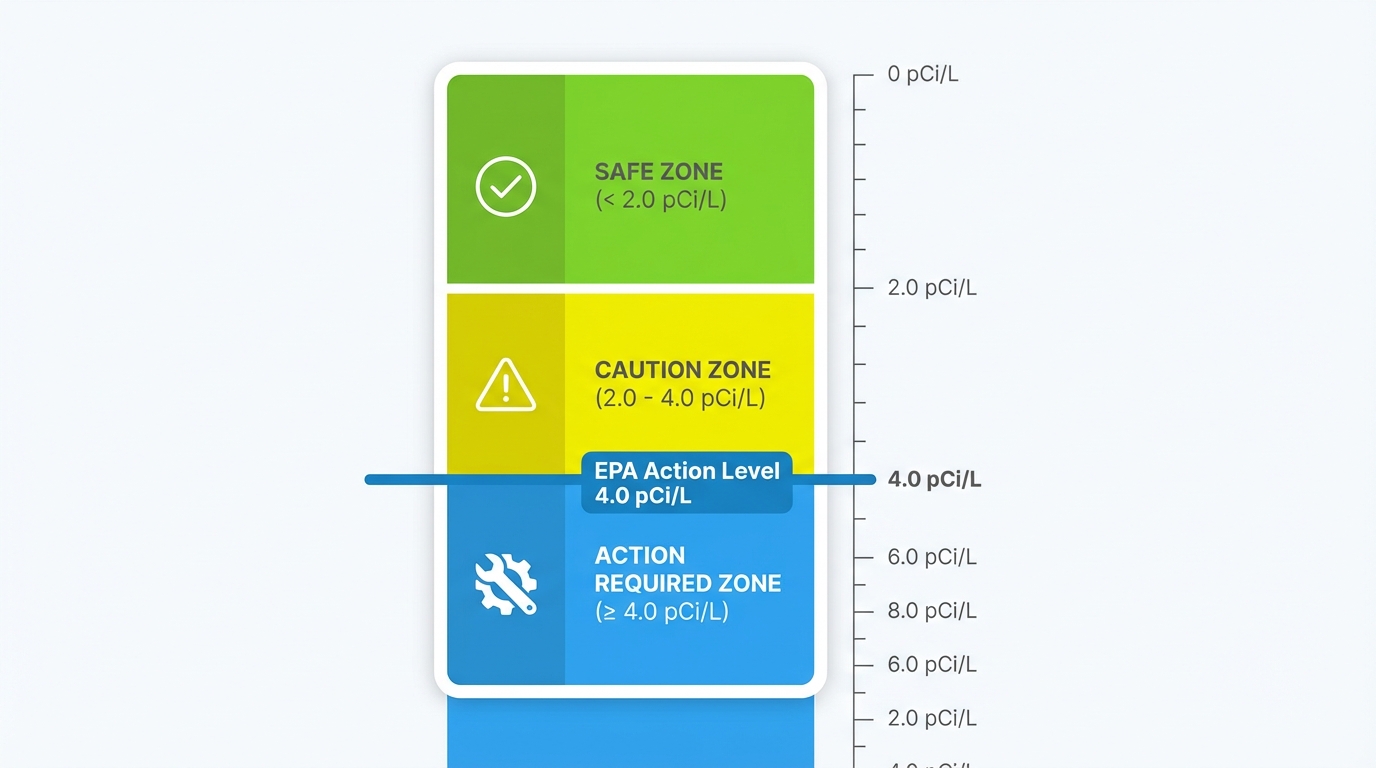
The EPA has established an action level of 4.0 pCi/L. If a radon test returns a result at or above that threshold, the agency recommends taking steps to reduce the level. However, the EPA also notes that homeowners should consider mitigation for levels between 2 and 4 pCi/L, because there is no known safe level of radon exposure. Risk increases with both concentration and duration — so a home that consistently registers 3.5 pCi/L over years still represents meaningful cumulative exposure.
It is important to understand that a single short-term test captures a snapshot. Radon levels fluctuate based on weather, barometric pressure, soil moisture, wind speed, and HVAC operation. A result of 3.8 pCi/L today could be 5.2 pCi/L next month. This is why professionals often recommend a follow-up test if the initial result is near the action level, and why long-term testing provides a more stable picture for decision-making.
Professional Radon Inspection Compared to a DIY Home Test Kit
Hardware store kits can serve as a preliminary screening tool. A homeowner places the charcoal canister or alpha-track detector in the home, waits the specified period, and mails it to a lab. The process is inexpensive, but it is also highly dependent on the user following placement and closed-house protocols correctly. There is no tamper detection, no hourly data log, and no professional oversight of conditions during the test.
A professional radon inspection uses continuous radon monitors (CRMs) that log readings every hour. This hourly data reveals patterns — for example, whether radon spikes at night when the HVAC is off, or whether a brief window opening during the test period affected results. Many CRMs also include tamper-detection features, which is important for real estate transactions where both buyer and seller need confidence in the data. The final report from a professional test typically includes device calibration details, start and end times, average concentration, hourly data chart, and test conditions — a level of documentation that a mail-in kit simply cannot provide.
| Factor | DIY Kit | Professional CRM Test |
|---|---|---|
| Hourly data log | No | Yes |
| Tamper detection | No | Yes (most devices) |
| Placement verification | User dependent | Technician verifies location and conditions |
| Turnaround time | 1-2 weeks (lab mail) | Results often available within days |
| Accepted for real estate | Sometimes, with limitations | Widely accepted with full documentation |
| Cost range | Lower upfront | Higher, but includes professional protocol |
Clean Air Houston Pro approaches radon inspection the same way it handles every indoor air quality service: with an inspection-first methodology, transparent reporting, and flat-rate pricing. Homeowners receive a clear explanation of the process before any equipment is deployed, and the final report includes everything needed for personal decision-making or real estate documentation.
“Stacy’s team was awesome fast and professional! They explained everything to me before they did anything. Very fair pricing. I will definitely use them again.”
Flat Rates | No Hidden Fees | Same-Day Service Available
Is a 48-Hour Radon Test Truly Accurate Enough to Make Decisions?
A properly conducted 48-hour test meets the minimum duration required by widely recognized measurement protocols, including those referenced by the EPA and ANSI/AARST standards. For real estate transactions that need a result quickly, a 48-hour CRM test with closed-house conditions is the standard approach. The hourly data log helps identify anomalies — if a storm caused a temporary spike, or if someone opened a window for an extended period, the data shows it.
That said, a 48-hour test is still a snapshot. Radon concentrations can vary by season (winter readings tend to be higher in many climates), by weather pattern, and by changes in building operation. If you plan to live in a home long-term and the short-term result is near the action level, investing in a long-term follow-up test (90+ days) provides a more representative annual average. Neither result is “wrong” — they simply answer different questions at different levels of precision.
What Should You Do When Radon Levels Come Back High?
A high result does not mean the home is uninhabitable or that the situation is an emergency. It means the data indicates a need for action. The first step is to review the test report carefully: Were closed-house conditions maintained? Was the device placed correctly? Were there unusual weather events during the test? If conditions were normal, the result is likely representative and mitigation planning should begin.
When a Retest Makes Sense Before Installing a Mitigation System
A retest is reasonable if the original test had known protocol deviations — a door left open for hours, an HVAC malfunction, or a test duration that barely met the 48-hour minimum during unusual conditions. For borderline results (4.0-4.5 pCi/L), a second short-term test or a long-term test can help confirm whether mitigation is warranted. The EPA suggests that if two short-term tests are performed, the average of the two results should guide the decision.
How Radon Mitigation and Radon Removal Actually Work
The term “radon removal” is common in searches, but it is worth clarifying: you cannot eliminate radon from the soil beneath your home. What a mitigation system does is intercept the gas before it enters the living space and redirect it safely outdoors. The most common and effective method is called sub-slab depressurization. A pipe is inserted through the foundation slab into the gravel or soil layer below. A fan mounted on the pipe creates a slight vacuum beneath the slab, drawing radon-laden soil gas into the pipe and venting it above the roofline where it disperses harmlessly into the outdoor atmosphere.
Crack sealing and joint caulking are often performed as supplemental steps, but they are rarely sufficient on their own. The active suction provided by the fan is the critical component. After a mitigation system is installed, a post-mitigation radon test is performed to verify that levels have dropped below the action threshold. Most properly designed systems reduce indoor radon by a significant margin. Clean Air Houston Pro can help coordinate the testing process before and after mitigation, ensuring that results are documented and verifiable at every stage.
Commercial Radon Testing — Schools, Offices, and Multi-Family Buildings in Houston
Radon is not exclusively a residential concern. Employees, students, and tenants in commercial and multi-family buildings can be exposed to elevated radon if the structure sits on soil that produces the gas. Commercial radon testing Houston TX follows specific protocols established by ANSI/AARST for multi-family and large buildings. These protocols address sampling density (how many test points per floor area), placement rules for different occupancy types, and documentation requirements that differ from single-family residential testing.
Property managers and building owners face additional considerations: testing must be planned to minimize disruption, results need to be communicated clearly to occupants, and any mitigation work must account for complex HVAC systems and large floor plates. Buildings with energy-efficient envelopes — tight construction, sealed ductwork, and high-performance insulation — can sometimes trap soil gases more effectively than older, leakier structures. This makes post-construction or post-retrofit testing especially important for commercial properties that have recently undergone upgrades.
Clean Air Houston Pro works with commercial property managers to plan multi-point testing that fits the building’s operational schedule. The team provides clear, professional documentation that satisfies regulatory and tenant-communication needs — the same transparent, inspection-first approach applied to every service.
“Very responsive and professional. They got me on their schedule day after I called. The technicians were knowledgeable and took time to explain everything.”
What a Reliable Radon Test Report Should Include
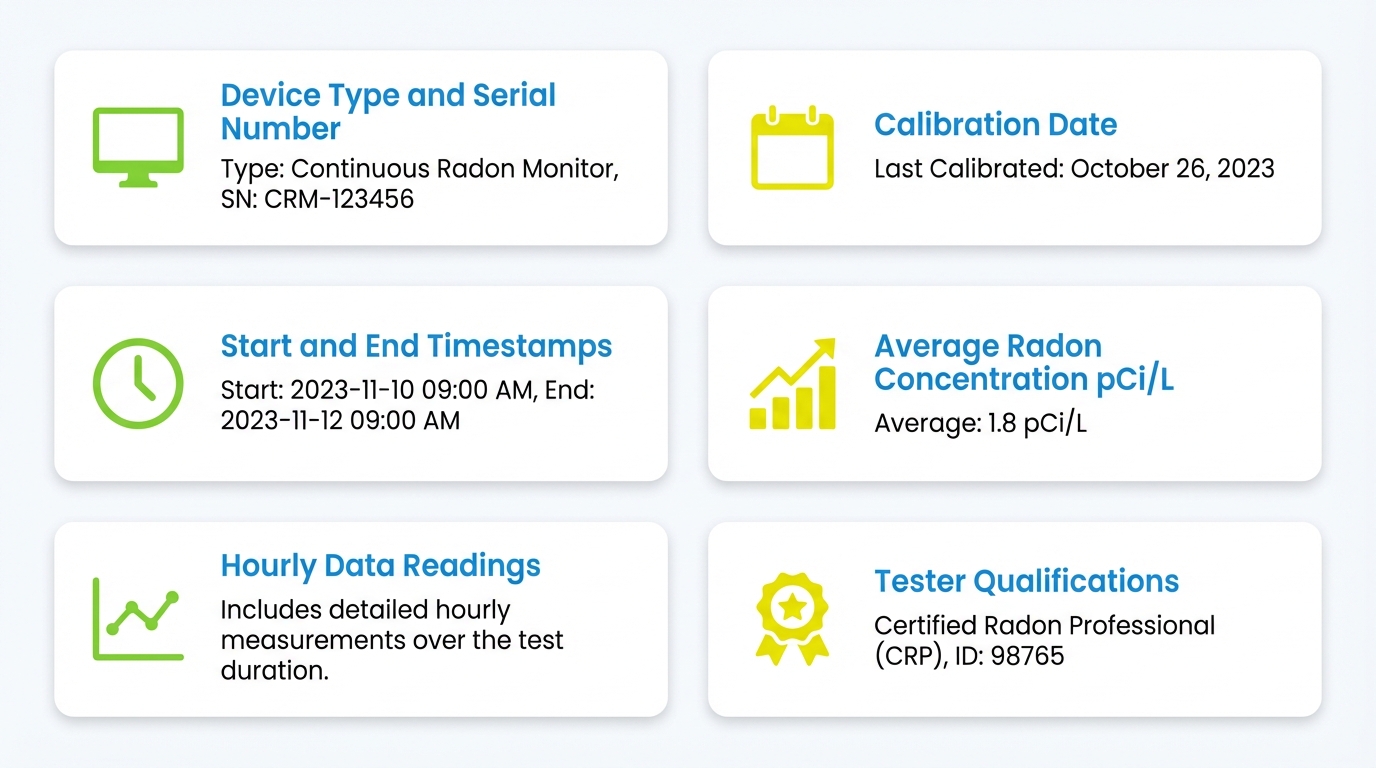
Whether you are reviewing a report for your own peace of mind or for a real estate closing, certain elements indicate a credible, properly conducted test. A trustworthy report should include:
- Device type and serial number
- Most recent calibration date
- Exact start and end timestamps
- Total test duration
- Average radon concentration in pCi/L
- Hourly or periodic data readings
- Description of the test location within the building
- Confirmation that closed-house conditions were discussed and agreed upon
- Name and qualifications of the person who deployed and retrieved the device
If a report lacks these details, or if results are presented as a single number with no supporting data, it is reasonable to question the reliability of the test. When working with Clean Air Houston Pro, homeowners and property managers receive detailed documentation that meets recognized standards — making the results useful for personal action plans, real estate negotiations, or commercial compliance records.
Radon is invisible and odorless — but its health effects are well documented. Get clear, professional data about the air inside your Houston home.
Or call us: (832) 737-8500
Frequently Asked Questions
+
+
+
+
+
+
Radon is invisible and odorless, which means it can accumulate for years without any obvious sign. A professional radon gas test is a straightforward, affordable step that gives you clear data — not guesses — about one of the most significant indoor air hazards recognized by federal health agencies.
Flat Rates | No Hidden Fees | Same-Day Service Available

