
Reading Time: 5 minutes
VOC Removal Houston: How to Identify, Test, and Eliminate Chemical Vapors in Your Home or Business
- VOCs are invisible gases released from paints, adhesives, flooring, furniture, and cleaning products that concentrate 2 to 5 times higher indoors than outdoors
- Houston’s heat and humidity accelerate off-gassing while sealed, air-conditioned homes trap chemical vapors inside
- HEPA filters capture particles but cannot remove VOCs — effective chemical odor removal requires gas-phase filtration such as activated carbon media
- Professional VOC removal follows a four-step process: source identification, ventilation strategy, gas-phase filtration, and post-treatment verification
- Vapor intrusion from contaminated soil near Houston industrial sites can introduce hazardous compounds through foundation cracks without any obvious interior source
+
- What Are Volatile Organic Compounds and Why Do They Matter?
- Where Do VOCs Come From Inside a Houston Home or Office?
- The Renovation That Will Not Stop Smelling
- How Do You Know If You Need VOC Testing?
- Why HEPA Filters Do Not Remove VOCs
- Does Activated Carbon Actually Work for VOC Removal?
- Three Mistakes Homeowners Make With Chemical Odors
- What Does a Professional VOC Removal Process Look Like?
- DIY vs. Professional VOC Removal Comparison
- Why VOC Readings Spike in the Afternoon
- Does Air Duct Cleaning Help With VOC Issues?
- Vapor Intrusion: A Houston-Specific Concern
- When Moisture and Chemicals Overlap
- How Long to Get Rid of VOC Smell After Renovation?
- VOC Removal for Commercial Spaces
- Frequently Asked Questions
If your Houston home or office has a persistent chemical smell — especially after a renovation, a move into new construction, or even after installing new flooring — you may be dealing with volatile organic compounds. VOCs are invisible gases released from everyday materials like paints, adhesives, cleaning products, composite wood furniture, and even some fabrics. According to the U.S. Environmental Protection Agency, concentrations of many VOCs are consistently 2 to 5 times higher indoors than outdoors, and sometimes far more during and immediately after activities like painting or stripping.
Houston’s warm, humid climate compounds the issue. High temperatures accelerate off-gassing from building materials, while sealed, air-conditioned interiors trap those vapors inside. That “new house smell” many homeowners associate with freshness is often a sign of active chemical off-gassing — and understanding what causes it is the first practical step toward cleaner, safer indoor air. This guide walks through the sources, testing methods, common mistakes, and professional strategies for effective VOC removal Houston residents and business owners can actually rely on.
What Exactly Are Volatile Organic Compounds and Why Do They Matter?
Volatile organic compounds are carbon-based chemicals that evaporate easily at room temperature. That evaporation — called off-gassing — releases vapors into the air you breathe. Some VOCs have noticeable odors like paint thinner or nail polish remover, while others are essentially odorless. The health effects of sustained exposure can range from eye and throat irritation to headaches, dizziness, and worsening of asthma or allergy symptoms. Certain VOCs, like formaldehyde and benzene, are classified as more serious long-term concerns by agencies including the CDC and EPA.
One important distinction: “VOC” is not a single chemical. It is a broad category encompassing hundreds of different compounds. As the EPA’s technical overview explains, what qualifies as a VOC can even depend on the measurement method used. This is why a general “Total VOC” reading from a consumer-grade monitor does not tell the full story — and why professional assessment matters when the goal is actual removal, not just a number on a screen.
Where Do VOCs Come From Inside a Houston Home or Office?
Understanding sources is critical because you cannot effectively pursue VOC removal without knowing what is producing the gases. Here are the most common indoor sources Houston homeowners and property managers encounter.
Building materials top the list: drywall joint compounds, construction adhesives, caulks, sealants, engineered wood products (particleboard, MDF, laminate), and carpet backing all release VOCs — sometimes for weeks or months after installation. Paints and finishes, including stains and polyurethane coatings, are among the highest short-term emitters.
Beyond construction, everyday products contribute too. Cleaning sprays, air fresheners, dry-cleaned clothing, printer and copier toner, and hobby supplies such as glues, markers, and solvents all add to the indoor chemical load. The Texas State Office of Risk Management specifically identifies carpets, glues, and office equipment as common IAQ culprits in Texas commercial buildings. Even products labeled “low-VOC” may still emit compounds that affect sensitive individuals — the label primarily relates to outdoor ozone-forming potential, not necessarily indoor health safety.
“They did a fantastic job. The Houston allergens and poor air quality in my home were problematic. Scheduling was easy, and the team was professional and thorough.”
A Scenario That Sounds Familiar: The Renovation That Will Not Stop Smelling
Consider a typical Houston scenario. A family completes a kitchen remodel: new cabinets, new LVP flooring, fresh paint, and updated countertop adhesive. The contractor finishes on a Friday. By Monday, with the house closed up and the AC running, the chemical smell is intense. They open windows for a day, it gets better, but every time they close up and the system kicks on, the odor returns — sometimes worse in the afternoon when the house warms up.
This pattern is not unusual. Heat accelerates off-gassing, so afternoon sun on exterior walls or a warm attic radiating down increases vapor release. The HVAC system then circulates those vapors throughout the home. Simply “airing out” does not address the ongoing emission from materials that may off-gas for weeks. This is precisely where a structured approach to VOC removal — source identification, targeted ventilation, and gas-phase filtration — becomes necessary rather than optional.
How Do You Know If You Need VOC Testing Before Attempting Removal?
Not every chemical odor requires laboratory testing, but testing becomes valuable in specific situations: when the odor source is unclear, when occupants are experiencing persistent symptoms such as burning eyes, headaches, or nausea, when you are evaluating a property before purchase or lease, or when initial remediation efforts have not resolved the issue. Professional VOC testing identifies which compounds are present and at what concentrations — information that directly shapes the removal strategy.
Air sampling for VOCs follows specific protocols. According to the New York State Department of Health guidance on indoor air sampling, samples should be collected in the “breathing zone” (roughly 3 to 6 feet above the floor), and occupants should avoid activities that could skew results — such as painting, heavy cleaning, or smoking — for a defined period before the test. A professional report will typically show concentrations of individual compounds or Total VOC, which helps determine whether levels are elevated compared to typical indoor baselines.
Consumer VOC Monitor vs. Professional Testing
Consumer-grade VOC monitors (the handheld devices available online) measure a general “Total VOC” index using a metal-oxide sensor. They can indicate relative changes — “higher than yesterday” or “spikes when I open this cabinet” — but they cannot identify specific chemicals, and their accuracy varies widely with humidity, temperature, and sensor age. Professional testing, by contrast, uses calibrated sampling equipment and laboratory analysis (such as TO-15 canisters or sorbent tubes) that can pinpoint individual compounds like formaldehyde, benzene, toluene, or xylene and report precise concentrations.
Our inspection-first approach identifies exactly what is in your air before recommending any treatment. No guesswork, no unnecessary services.
Schedule Your Air Quality Assessment
Or call us: (832) 737-8500
Why Standard HEPA Filters Do Not Remove VOCs
This is one of the most common misconceptions. Many Houston homeowners invest in a HEPA air purifier expecting it to resolve a chemical odor — and are frustrated when the smell persists. The reason is straightforward: HEPA filters are engineered to capture particles (dust, pollen, pet dander, mold spores) down to 0.3 microns. VOCs, however, are gases — individual molecules far smaller than any particle filter can trap.
The EPA states clearly that air cleaning devices without gas-phase filtration media will not meaningfully reduce gaseous pollutants, including most VOCs. Effective chemical odor removal requires media designed to adsorb or react with gas-phase molecules — typically activated carbon, potassium permanganate, or specialized alumina blends — and the system must be sized correctly for the space and airflow involved.
| Filtration Type | Captures Particles | Captures VOC Gases | Best Use Case |
|---|---|---|---|
| Standard HVAC Filter (MERV 8-13) | Yes (moderate) | No | General dust control |
| HEPA Filter | Yes (high efficiency) | No | Allergens, fine particles |
| Activated Carbon Media | Minimal | Yes (broad-spectrum) | VOCs, chemical odors |
| Carbon + HEPA Combination | Yes | Yes | Comprehensive IAQ |
| Photocatalytic / UV Oxidation | No | Partial (varies widely) | Supplemental only |
Does Activated Carbon Actually Work for VOC Removal — and When Does It Fail?
Activated carbon is the most widely used adsorbent for gas-phase VOCs, and when properly deployed, it can be highly effective. The carbon’s porous structure traps VOC molecules on its surface through a process called adsorption. However, effectiveness depends on several variables: the amount of carbon media, the airflow rate through it (contact time), the specific VOCs present, relative humidity, and temperature. A small consumer carbon filter may help slightly in a single room, but it will not meaningfully reduce VOC levels in a whole-home scenario with active off-gassing sources.
The most common failure point is saturation. Carbon media has a finite adsorption capacity — once it is “full,” it stops working and can even begin releasing trapped compounds back into the air (a phenomenon called desorption). High humidity, common in Houston, can also reduce carbon effectiveness because water vapor competes for adsorption sites. A professional approach accounts for these factors by calculating the appropriate media volume, replacing it on a schedule, and pairing it with ventilation strategies rather than relying on filtration alone.
Three Mistakes Homeowners Make When Trying to Handle Chemical Odors
Mistake 1: Masking the odor instead of removing the source. Air fresheners, scented candles, and odor-neutralizing sprays may temporarily cover a chemical smell, but they add their own VOCs to the indoor environment. The underlying compounds remain, and in some cases the combined chemical load actually worsens air quality. Effective chemical odor removal addresses the vapor source, not just the perception of smell.
Mistake 2: Relying on open windows as the complete solution. Ventilation helps — but in Houston, opening windows during summer means introducing hot, humid air that can increase off-gassing rates and strain the HVAC system. Strategic ventilation (timed, directed, sometimes mechanically assisted) is different from simply cracking a window and hoping for the best.
Mistake 3: Assuming the problem will “just go away” with time. Some VOC sources do diminish over weeks. Others — particularly composite wood products emitting formaldehyde — can continue off-gassing for months or even years at lower levels. Without identifying and addressing the source, waiting can mean prolonged exposure with no clear endpoint.
“Stacy’s team was awesome fast and professional! They explained everything to me before they did anything. Very fair pricing. I will definitely use them again.”
What Does a Professional VOC Removal Process Look Like in Houston?
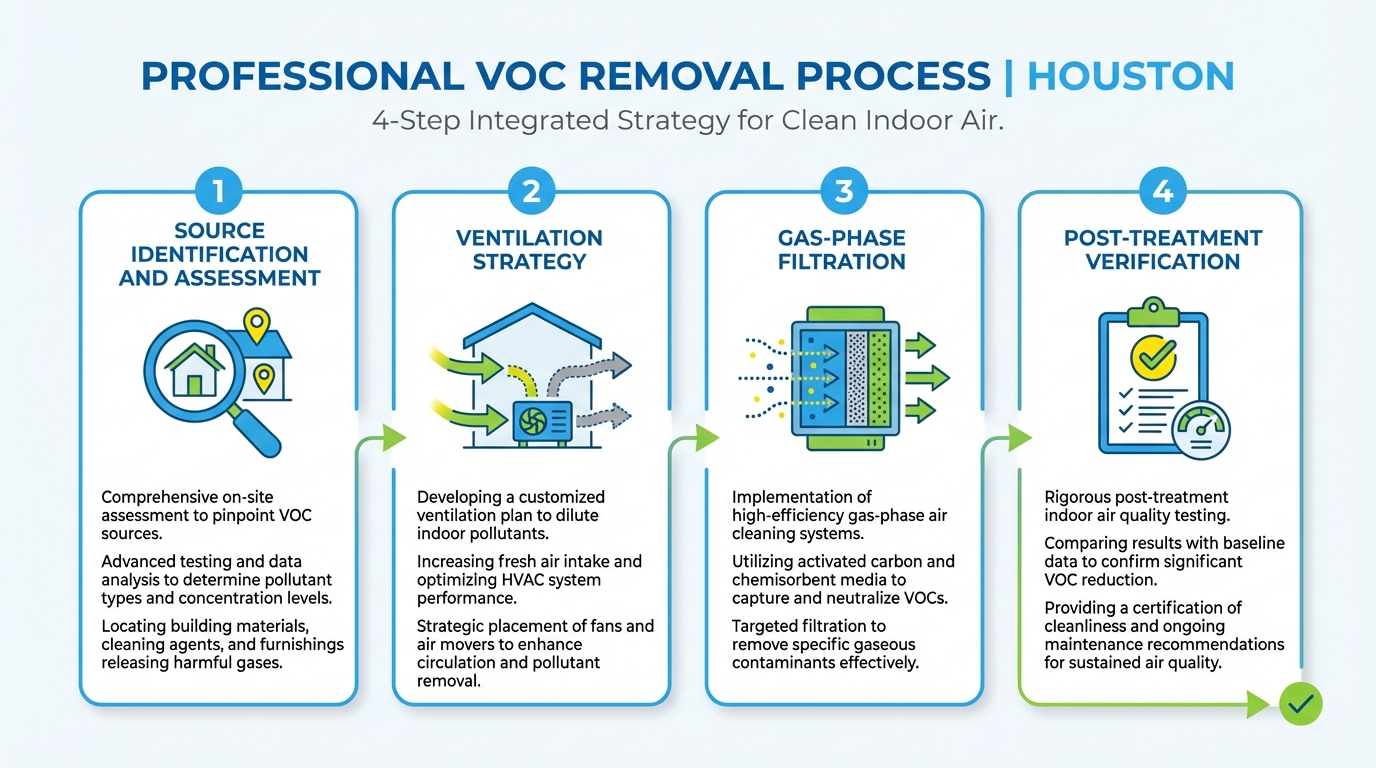
A credible VOC removal process follows a logical sequence rather than jumping straight to equipment. The approach recommended by ASHRAE and reflected in EPA guidance prioritizes source control first, enhanced ventilation second, and air purification third. Here is how that translates into practice for a Houston home or commercial space.
Step 1 — Source Identification and Assessment
Before any equipment is deployed, a technician inspects the space to identify likely emission sources. This includes examining recently installed materials, checking storage areas for chemicals, evaluating HVAC components, and reviewing any prior testing data. In commercial settings, this step also maps zones by use type (copy rooms, supply closets, break areas) since each may have different chemical profiles. Clean Air Houston Pro uses an inspection-first approach for all indoor air quality concerns, ensuring the strategy targets actual problems rather than guessing.
Step 2 — Ventilation Strategy
Once sources are identified, the next step is establishing effective air exchange. This may involve adjusting the HVAC system to increase outdoor air intake, using exhaust fans to create negative pressure in affected zones, or scheduling intensive ventilation during off-peak hours when the space is unoccupied. The goal is dilution — replacing contaminated indoor air with cleaner air — without creating comfort or humidity problems.
Step 3 — Gas-Phase Filtration
For situations where ventilation alone cannot reduce VOC levels quickly enough (high source strength, occupied spaces, or building envelope constraints), targeted air scrubbing with activated carbon or specialized media provides active removal. Professional-grade units are sized to the space volume, and media is selected based on the specific contaminants identified during assessment. This is where flat-rate, transparent service matters — Clean Air Houston Pro provides clear pricing with no hidden fees so property owners know exactly what they are getting before work begins.
Step 4 — Post-Treatment Verification
After treatment, air quality is re-evaluated — either through follow-up VOC testing or at minimum through a post-inspection to confirm that odors have resolved and airflow is performing as expected. This verification step closes the loop and provides documentation that the issue has been addressed, which is especially valuable for commercial tenants, property managers, and real estate transactions.
Comparing DIY Approaches to Professional VOC Removal
| Factor | DIY Approach | Professional VOC Removal |
|---|---|---|
| Source Identification | Trial and error; based on smell | Systematic inspection and optional lab testing |
| Equipment | Consumer air purifier, open windows | Commercial air scrubbers, carbon media systems |
| Effectiveness on Gases | Limited; HEPA does not capture VOCs | Targeted gas-phase filtration matched to contaminants |
| Timeline | Weeks to months of hoping it fades | Days to weeks with structured protocol |
| Verification | Subjective (“does it still smell?”) | Measurable follow-up testing or documented post-inspection |
| Cost Predictability | Varies; risk of buying ineffective products | Flat-rate pricing, defined scope |
Why Do VOC Readings Spike in the Afternoon or When the HVAC Kicks On?

This is a question that comes up frequently on homeowner forums and in service calls. The answer involves basic chemistry: higher temperatures increase the vapor pressure of volatile compounds, which accelerates their release from materials. In a Houston home, afternoon sun heats exterior walls, attic spaces radiate warmth downward, and interior temperatures rise even with air conditioning running. Each degree of temperature increase can noticeably boost off-gassing rates from flooring, cabinets, and adhesives.
When the HVAC system activates, it creates airflow that stirs up and distributes these newly released vapors throughout the ductwork and into every room connected to the system. If the return air path passes near high-emission areas (a freshly painted room, a new-carpet hallway), the system essentially becomes a distribution network for chemical vapors. This is also why some occupants notice the smell specifically when they hear the system turn on — the correlation is real, not imagined.
Flat Rates | No Hidden Fees | Same-Day Service Available
Does Cleaning Your Air Ducts Help With VOC Issues?
This is a nuanced question, and the honest answer is: sometimes, but duct cleaning alone is not a VOC solution. VOCs are gases generated by materials in the living space, not by dust in the ductwork. However, there is a legitimate connection. Dust and debris inside ducts can adsorb VOC molecules over time, and when air flows across that contaminated dust, it can release low-level chemical odors back into the space. If your chemical odor issue seems tied specifically to when the HVAC runs, having the duct system professionally inspected and cleaned can be a worthwhile supporting step.
Clean Air Houston Pro’s professional air duct cleaning service uses HEPA-filtered negative-pressure equipment to remove accumulated dust and debris without spreading it into your living space. While this addresses the particulate side, a comprehensive VOC situation typically requires the additional gas-phase strategies described above. The value of duct cleaning in this context is removing one contributing layer — trapped chemical residue on dust — as part of a broader indoor air quality improvement plan.
Vapor Intrusion: A Houston-Specific Concern Many Homeowners Miss
Not all indoor VOCs come from paint cans and new furniture. In parts of Houston, particularly near current or former industrial sites, chemical vapors from contaminated soil or groundwater can migrate upward through foundation cracks, utility penetrations, and slab joints into the building above. This process, called vapor intrusion, can introduce compounds like benzene, trichloroethylene (TCE), or petroleum hydrocarbons into indoor air without any obvious interior source.
The Texas Department of State Health Services provides specific guidance on vapor intrusion investigations, noting that chemical vapors from subsurface contamination can enter through even small openings in a building’s foundation. For Houston properties located near refineries, chemical plants, former gas stations, or known contamination sites, professional VOC testing that includes an evaluation of potential subsurface sources is an important step. If vapor intrusion is confirmed, mitigation typically involves sub-slab depressurization systems or vapor barriers — specialized work that goes beyond standard air cleaning.
When Moisture and Chemicals Overlap: VOCs, Mold, and Combined IAQ Problems
Houston’s humidity creates a secondary concern that compounds VOC issues. Moisture intrusion — from roof leaks, plumbing failures, condensation on ductwork, or flooding — can lead to mold growth, which produces its own set of volatile compounds (microbial VOCs or mVOCs). When a building has both material off-gassing and moisture problems, occupants may experience a confusing mix of chemical and musty odors that seem to resist any single treatment approach.
Addressing this overlap requires evaluating both the chemical and biological dimensions of the indoor air. If moisture damage is present alongside VOC concerns, expert mold remediation may be needed to resolve the biological component before or alongside the chemical treatment. Ignoring one while treating the other often leads to incomplete results and ongoing complaints.
“Very responsive and professional. They got me on their schedule day after I called. The technicians were knowledgeable and took time to explain everything.”
How Long Does It Take to Get Rid of VOC Smell After a Renovation?

There is no single answer because duration depends on the type of materials installed, the volume of the space, temperature, humidity, and how much ventilation is provided. Latex paint, for example, typically off-gasses most of its VOCs within the first 2 to 4 weeks. Engineered wood products and laminate adhesives can continue releasing formaldehyde at lower levels for months. Polyurethane floor finishes may produce noticeable odor for several weeks even with good ventilation.
Without intervention, a heavily renovated Houston home with limited ventilation could retain chemical odors for 2 to 6 months or longer. With a professional VOC removal protocol — source assessment, strategic ventilation, and gas-phase scrubbing — that timeline can often be compressed to days or a few weeks, depending on source severity. The key variable is whether the ongoing emission rate from materials is low enough for ventilation and filtration to stay ahead of it. A professional assessment provides that clarity so you are not just guessing at timelines.
What About Commercial Spaces — Offices, Clinics, and Retail?
VOC concerns in commercial spaces carry additional complexity. Businesses cannot simply “open windows for a week” — they have tenants, employees, patients, or customers who need the space to function. Post-construction or post-renovation chemical odors in commercial environments often trigger employee complaints, and in some cases, regulatory attention. Property managers need solutions that work within operational constraints: after-hours treatment, zone-by-zone approaches, and minimal disruption to daily business.
Clean Air Houston Pro works with commercial clients to develop practical VOC removal plans that account for occupancy schedules, HVAC zoning, and the specific materials involved. The inspection-first approach ensures that remediation is targeted rather than generic, and flat-rate pricing means property managers can budget accurately without worrying about escalating costs. For multi-tenant buildings, this structured process also provides documentation that can satisfy tenant concerns and demonstrate due diligence.
We work with property managers throughout Houston to resolve VOC issues with minimal disruption to tenants and operations. After-hours service available.
Request a Commercial Assessment
Or call us: (832) 737-8500
Frequently Asked Questions
+
+
+
+
+
+
Whether it is a renovation that will not stop smelling, unexplained headaches, or a commercial space with air quality complaints — Clean Air Houston Pro identifies the source and eliminates it.
Flat Rates | No Hidden Fees | Same-Day Service Available

