
Reading Time: 5 minutes
Air Duct Problems Houston: What You Need to Know
- Houston homes lose 20-30% of conditioned air through duct leaks, significantly increasing energy bills
- Uneven temperatures and musty odors are primary warning signs of ductwork problems
- Houston’s extreme humidity accelerates duct deterioration and promotes mold growth
- Professional duct sealing can improve HVAC efficiency by 20% or more
- Early detection prevents costly HVAC equipment damage and protects indoor air quality
+
- Understanding Air Duct Problems in Houston
- Recognizing the Signs of Damaged Air Ducts
- How Air Duct Problems Affect Your Health
- What Happens When Your HVAC System Works Too Hard
- Why Houston’s Climate Makes Duct Problems Worse
- Is It a Duct Problem or an HVAC Equipment Issue
- What Does Professional Duct Sealing Involve
- When Should You Repair Ducts Versus Replace Them
- Does Duct Cleaning Actually Help
- Why Is Duct Insulation Critical in Houston Homes
- What Can You Safely Handle Yourself
- Comparing Duct Services: What Each Option Solves
- Frequently Asked Questions
Understanding Air Duct Problems in Houston
Houston homeowners face a unique set of challenges when it comes to maintaining their air duct systems. The combination of extreme heat and high humidity creates conditions that accelerate wear on ductwork while simultaneously increasing the demand on HVAC systems. Understanding air duct problems Houston residents commonly encounter is the first step toward protecting your home comfort and indoor air quality.
Compromised ductwork affects more than just temperature control. When ducts develop leaks, disconnections, or insulation failures, your entire HVAC system struggles to perform efficiently. This leads to higher energy bills, uneven temperatures throughout your home, and potentially serious indoor air quality concerns. The hot and humid Houston climate makes these issues particularly problematic, as moisture-related complications can develop quickly in damaged duct systems.
Clean Air Houston Pro specializes in identifying and resolving ductwork problems specific to the greater Houston area. Their technicians understand how local climate conditions impact air distribution systems and provide tailored solutions that address both immediate concerns and long-term performance.
Recognizing the Signs of Damaged Air Ducts
Identifying duct problems early can save significant money on repairs and prevent secondary damage to your HVAC equipment. Several warning signs indicate your ductwork may need professional attention. Recognizing these symptoms helps you take action before minor issues become major expenses.
High Energy Bills
When your energy costs increase without a corresponding change in usage habits, compromised ductwork is often responsible. According to Energy Star, a typical home loses 20 to 30 percent of conditioned air through leaks, holes, and poorly connected ducts. This means your HVAC system must run longer and work harder to achieve the desired temperature, consuming significantly more electricity in the process.
Uneven Heating and Cooling
Hot and cold spots throughout your home often point to duct issues rather than equipment problems. When certain rooms consistently fail to reach comfortable temperatures while others cool efficiently, the problem typically lies in the air distribution system. Leaks, crushed flexible ducts, or disconnected sections prevent conditioned air from reaching its intended destination. Energy Star notes that uneven temperatures between rooms can signal that ducts are not flowing sufficient air to certain areas.
Poor Indoor Air Quality
Leaky return ducts create a particularly concerning problem for indoor air quality. The U.S. Department of Energy explains that compromised return ducts can pull unconditioned air directly into the system from attics, crawlspaces, or basements. This unconditioned air often contains dust, insulation particles, and other contaminants that get distributed throughout your living spaces.
Strange Noises or Odors from Vents
Whistling sounds coming from your vents typically indicate air escaping through gaps or holes in the ductwork. Rattling or popping noises may suggest loose connections or metal ducts expanding and contracting. Perhaps most concerning are musty or stale odors, which often signal moisture accumulation and potential mold growth within the duct system. Research published in PubMed confirms that musty odor serves as a strong indicator of dampness and mold presence, even when visible growth is not apparent.
“They did a fantastic job. The Houston allergens and poor air quality in my home were problematic. Scheduling was easy, and the team was professional and thorough.”
How Air Duct Problems Affect Your Health
The connection between ductwork condition and respiratory health is well-documented in scientific literature. When air ducts develop problems, they can become pathways for contaminants to enter your living spaces. Understanding these health implications emphasizes why addressing duct issues promptly matters beyond simple comfort concerns.
Exposure to mold spores, dust, and other airborne contaminants circulated through compromised ducts can trigger or worsen respiratory symptoms. Common reactions include persistent sneezing, coughing, watery eyes, and skin irritation. For individuals with existing conditions like asthma or allergies, the effects can be significantly more pronounced.
The World Health Organization guidelines published on NCBI confirm that dampness and mold have been consistently associated with respiratory symptoms, particularly asthma, wheeze, cough, respiratory infections, and upper respiratory tract symptoms. The CDC further notes that mold exposure can cause asthma attacks and irritate the eyes, nose, throat, and skin.
If you notice a persistent musty smell suggesting mold presence, or if visible mold growth appears within your ductwork, addressing the issue promptly is crucial. Clean Air Houston Pro can help you learn more about mold remediation services to protect your family’s health.
Our certified technicians can inspect your ductwork and identify potential health hazards affecting your family.
Or call us: (832) 737-8500
What Happens When Your HVAC System Works Too Hard
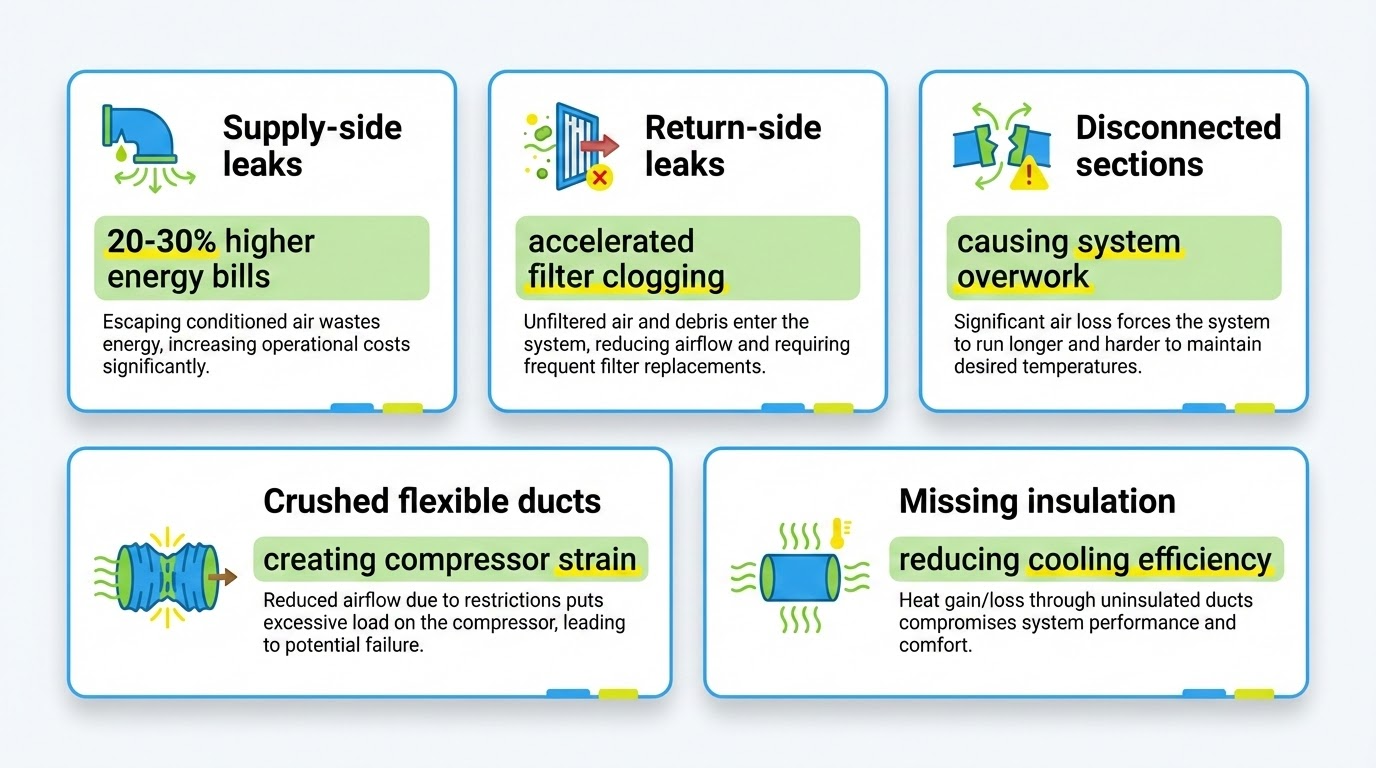
Duct problems create a cascade effect that impacts your entire heating and cooling system. When conditioned air escapes through leaks before reaching your living spaces, the HVAC unit compensates by running longer cycles. This increased operational demand accelerates wear on critical components including compressors, fan motors, and electrical systems.
The financial consequences extend beyond elevated utility bills. Premature equipment failure requires expensive repairs or early replacement of systems that should last 15 to 20 years. A system that runs 30 percent more than necessary due to duct leaks accumulates wear equivalent to years of normal operation in a much shorter timeframe.
| Duct Problem | HVAC Impact | Potential Cost Consequence |
|---|---|---|
| Supply-side leaks | Conditioned air lost to unconditioned spaces | 20-30% higher energy bills |
| Return-side leaks | Contaminated air pulled into system | Accelerated filter clogging and coil fouling |
| Disconnected sections | Complete loss of airflow to affected areas | System overwork and early failure |
| Crushed flexible ducts | Restricted airflow causing pressure imbalance | Compressor strain and refrigerant issues |
| Missing insulation | Heat gain in attic runs during summer | Significantly reduced cooling efficiency |
Why Houston’s Climate Makes Duct Problems Worse
The greater Houston area presents particularly challenging conditions for air duct systems. Understanding how local climate factors affect your ductwork helps explain why problems that might be minor in other regions become significant concerns here.
Houston’s subtropical humidity means moisture is constantly present in the air. When ducts running through unconditioned attic spaces develop leaks, warm humid air contacts the cooler duct surfaces. This temperature differential causes condensation to form on and around the ductwork. Over time, this moisture accumulates in insulation materials, creating ideal conditions for mold growth and material degradation.
Extreme summer temperatures in Houston attics, which can exceed 140 degrees Fahrenheit, stress duct materials and connections. Repeated thermal expansion and contraction loosens joints and can cause tape and mastic sealants to fail prematurely. The constant cycling between extreme heat during the day and cooling at night accelerates this degradation process.
“Stacy’s team was awesome fast and professional! They explained everything to me before they did anything. Very fair pricing. I will definitely use them again.”
Is It a Duct Problem or an HVAC Equipment Issue
Distinguishing between ductwork problems and equipment malfunctions prevents wasted money on unnecessary repairs. Many homeowners replace functioning HVAC components when the actual issue lies in the air distribution system. Several diagnostic indicators help differentiate between these two categories of problems.
Equipment issues typically affect the entire home uniformly. If no rooms are cooling adequately and the system runs constantly without producing cold air, the problem likely involves the HVAC unit itself. Refrigerant leaks, compressor failures, and electrical problems fall into this category.
Duct problems produce inconsistent results throughout the house. When some rooms cool perfectly while others remain warm, when certain vents produce strong airflow while others barely move air, the distribution system is the likely culprit. Similarly, if your system achieves adequate temperatures but energy consumption seems excessive, duct leaks are often responsible.
Clean Air Houston Pro provides comprehensive diagnostic assessments that identify whether problems originate in the equipment, the ductwork, or a combination of both factors. This thorough approach ensures repairs address actual causes rather than symptoms.
Flat Rates | No Hidden Fees | Same-Day Service Available
What Does Professional Duct Sealing Involve
Professional duct sealing addresses air leaks using specialized materials and techniques that provide lasting results. The process differs significantly from DIY approaches that often fail within months. Understanding what proper sealing entails helps homeowners evaluate service quality and make informed decisions.
Qualified technicians begin with a thorough inspection of the entire duct system, including sections in attics, crawlspaces, and wall cavities. They identify all leaks, disconnections, and damage requiring attention. Testing equipment measures actual airflow and pressure differentials to quantify the problem’s severity.
According to Energy Star guidelines, professional contractors seal ducts with mastic, metal-backed tape, or other approved sealing materials rather than standard duct tape, which deteriorates quickly. Mastic sealant forms a permanent flexible bond that accommodates normal thermal expansion without cracking. For larger gaps or damaged sections, technicians may apply reinforcing mesh before sealing.
The benefits of professional sealing extend beyond energy savings. Properly sealed ducts improve comfort by ensuring conditioned air reaches its intended destination. They enhance indoor air quality by preventing contaminated air from entering the system. Energy Star research indicates that sealing duct air leaks is often the most cost-effective way to improve home energy efficiency and indoor air quality simultaneously.
When Should You Repair Ducts Versus Replace Them
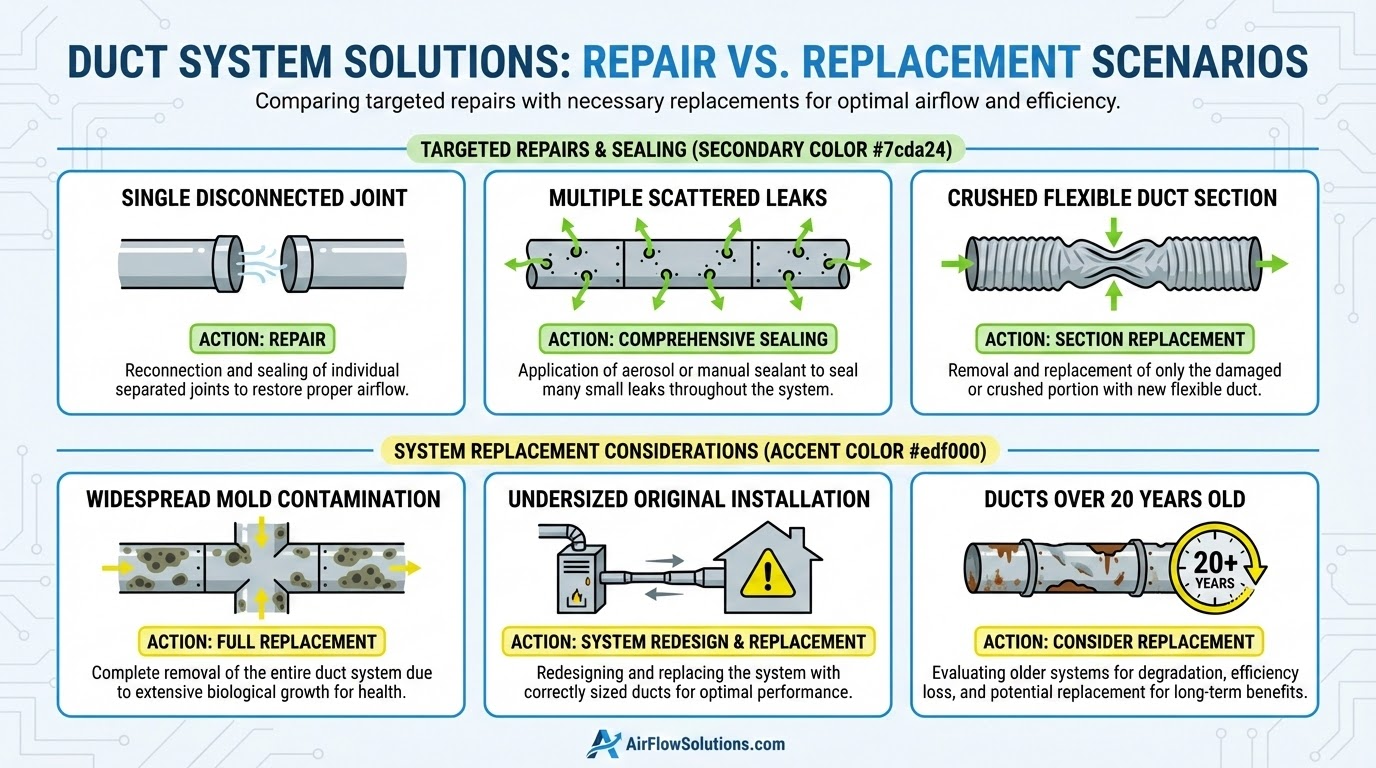
The decision between repair and replacement depends on several factors including the extent of damage, duct age, material condition, and overall system design. Making the right choice prevents both unnecessary expense and inadequate solutions.
Repair makes sense when damage is localized and accessible. Isolated tears, disconnected joints, or crushed flexible duct sections in accessible locations can often be fixed cost-effectively. If the overall duct system is properly sized, well-designed, and less than 15 years old, targeted repairs typically provide excellent results.
Replacement becomes the better option when problems are widespread or fundamental. Systems with extensive deterioration, pervasive mold contamination, or severely degraded insulation often cost more to repair than replace. Undersized ducts that never delivered adequate airflow require replacement regardless of their physical condition. Poorly designed systems with excessive runs, sharp bends, or inadequate return capacity benefit from complete redesign rather than patchwork repairs.
| Scenario | Recommended Approach | Key Considerations |
|---|---|---|
| Single disconnected joint | Repair | Quick fix if accessible |
| Multiple scattered leaks | Comprehensive sealing | Professional testing recommended |
| Crushed flexible duct section | Section replacement | Match existing duct specifications |
| Widespread mold contamination | Full replacement | Must address moisture source first |
| Undersized original installation | System redesign | Requires load calculation |
| Ducts over 20 years old with recurring issues | Consider replacement | Evaluate total repair cost history |
Does Duct Cleaning Actually Help
Duct cleaning generates significant debate among homeowners and industry professionals. Understanding when cleaning provides genuine benefit versus when it represents unnecessary expense helps you make informed decisions about this service.
The Environmental Protection Agency does not recommend routine duct cleaning and states that no evidence proves it prevents health problems. However, the EPA does recommend considering duct cleaning under specific circumstances: when substantial visible mold growth exists inside ducts, when ducts are infested with insects or rodents, or when ducts are clogged with excessive dust and debris that is actually being released into living spaces.
The key distinction involves whether contaminants are actually entering your home versus simply existing within the duct system. Sealed ducts with minor internal dust accumulation pose minimal concern. Ducts actively releasing particles into living spaces or harboring active mold growth warrant professional attention.
When cleaning is appropriate, the EPA emphasizes that addressing the underlying cause matters more than the cleaning itself. Mold growth requires moisture control. Pest infestations require extermination and entry point sealing. Without correcting root causes, problems will return regardless of how thoroughly ducts are cleaned. While not always needed, professional duct cleaning services are recommended if visible mold is present or significant contamination exists.
“Very responsive and professional. They got me on their schedule day after I called. The technicians were knowledgeable and took time to explain everything.”
Why Is Duct Insulation Critical in Houston Homes
Duct insulation plays a crucial role in Houston homes that exceeds its importance in milder climates. The extreme temperature differential between attic spaces and conditioned air creates conditions where uninsulated or poorly insulated ducts lose substantial cooling capacity.
During Houston summers, attic temperatures routinely exceed 130 degrees while air conditioning systems produce air around 55 degrees. This 75-degree or greater temperature differential causes rapid heat transfer into uninsulated ducts. By the time air travels through attic ductwork to distant rooms, it may warm significantly, reducing comfort and forcing the system to work harder.
The Department of Energy recommends insulating ducts in unconditioned spaces with at least R-6 insulation, noting that proper insulation is even more critical in hot and humid climates for cooling efficiency and condensation prevention. In Houston specifically, many professionals recommend R-8 insulation for optimal performance.
Condensation presents another insulation-related concern. When cold duct surfaces contact humid attic air, moisture forms on the duct exterior. This condensation can drip onto ceilings, soak into insulation materials, and promote mold growth. Proper insulation maintains duct surface temperatures above the dew point, preventing condensation formation.
What Can You Safely Handle Yourself
Some duct-related tasks fall within reasonable DIY capability while others require professional expertise and equipment. Knowing which category your situation falls into prevents both unnecessary service calls and inadvertent damage from improper repairs.
Homeowners can safely perform basic maintenance and inspection tasks. Replacing air filters according to manufacturer recommendations maintains airflow and protects equipment. Visual inspection of accessible duct sections in basements or utility areas identifies obvious damage. Ensuring supply and return vents remain unobstructed by furniture or belongings optimizes air distribution. Checking that all register dampers are properly positioned confirms intended airflow patterns.
Professional assistance becomes necessary for work involving attic access, ductwork modification, or sealing. Attic environments present safety hazards including extreme heat, limited visibility, and unstable footing. Improper sealing techniques can restrict airflow, creating pressure imbalances that reduce efficiency and potentially damage equipment. The Department of Energy specifically recommends hiring professionals familiar with proper duct sealing methods rather than attempting these repairs independently.
Suspected mold contamination always warrants professional assessment. Disturbing mold growth without proper containment and protection can release spores throughout your home, potentially worsening the problem. The CDC provides specific guidance on mold cleanup that emphasizes appropriate personal protective equipment and containment procedures that typically exceed homeowner capabilities.
Comparing Duct Services: What Each Option Actually Solves
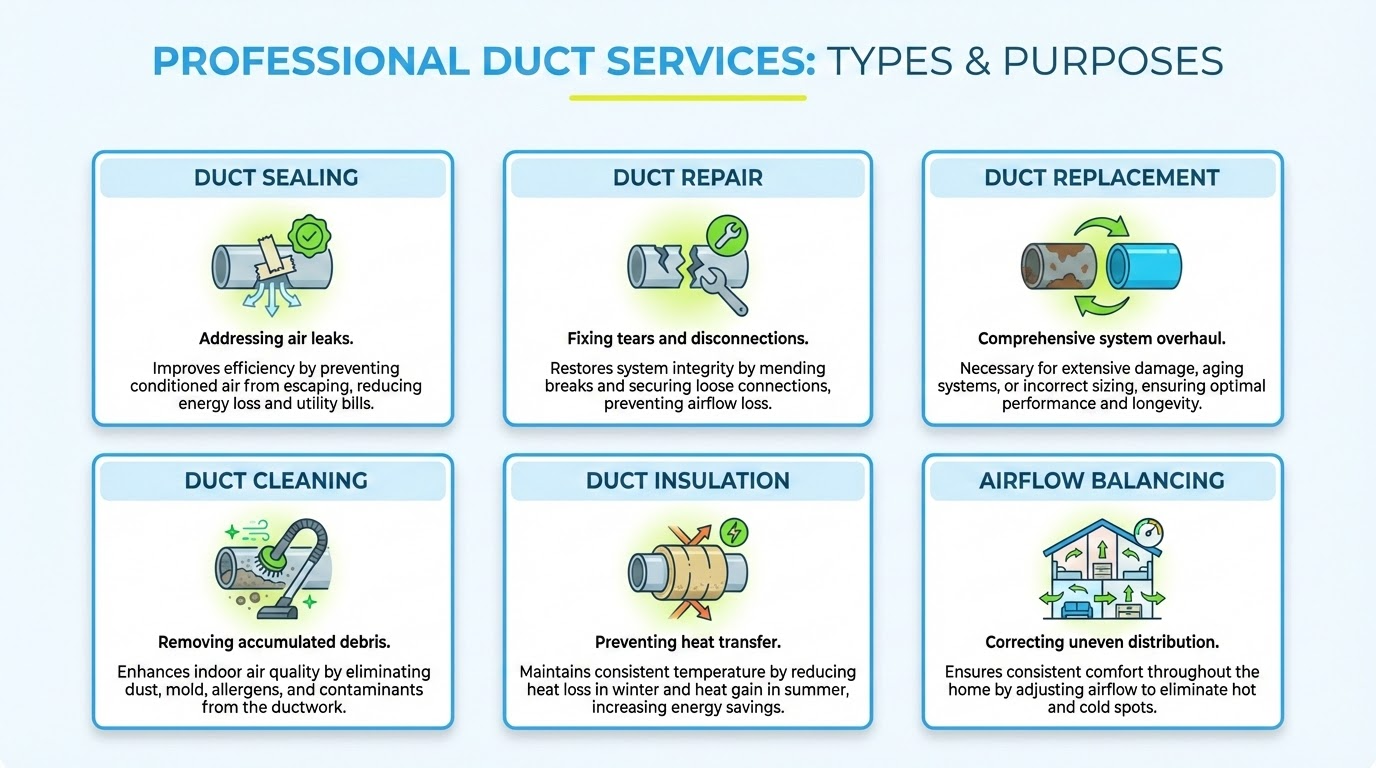
Different duct services address different problems. Understanding what each service accomplishes prevents confusion and ensures you request appropriate solutions for your specific situation.
| Service Type | What It Addresses | When Appropriate |
|---|---|---|
| Duct Sealing | Air leaks at joints and connections | High energy bills, pressure imbalances |
| Duct Repair | Tears, disconnections, crushed sections | Localized damage in accessible areas |
| Duct Replacement | Comprehensive system problems | Extensive damage, old systems, poor design |
| Duct Cleaning | Accumulated debris, surface contamination | Visible mold, pest evidence, post-renovation |
| Duct Insulation | Heat transfer, condensation prevention | Attic runs, unconditioned space ducts |
| Airflow Balancing | Uneven distribution between rooms | Temperature inconsistency with intact ducts |
Frequently Asked Questions

+
+
+
+
+
+
Join over 2,500 Houston homeowners who trust Clean Air Houston Pro for their indoor air quality needs.
Flat Rates | No Hidden Fees | Same-Day Service Available
Have you noticed any of the warning signs discussed throughout this article? Whether you are experiencing uneven temperatures, rising energy costs, unusual odors, or simply want peace of mind about your home’s air distribution system, professional assessment provides the answers you need.
Clean Air Houston Pro offers comprehensive duct inspection, repair, sealing, and cleaning services tailored to Houston’s unique climate challenges. Their experienced technicians identify problems accurately, explain findings clearly, and recommend appropriate solutions without unnecessary upselling. Taking action now prevents minor issues from developing into major expenses while improving your home’s comfort and air quality.
Contact Clean Air Houston Pro today to schedule your duct system evaluation and discover how proper ductwork maintenance can transform your home comfort.

