
Reading Time: 5 minutes
New Construction HVAC Houston: Your Complete Guide to Getting It Right the First Time
- Proper HVAC sizing requires Manual J load calculations, not square footage estimates
- SEER2 ratings now reflect real-world performance with higher efficiency standards for Houston homes
- Construction dust and debris can contaminate new ductwork without proper protection measures
- Houston requires mechanical permits and inspections for all new HVAC installations
- System commissioning verifies your investment performs according to design specifications
+
- Why Expert HVAC Design Matters for Your New Houston Home
- What Do SEER2 Ratings Mean for Your New Construction Budget
- How Does Construction Activity Affect Indoor Air Quality
- Which Permits and Inspections Does Houston Require
- What Happens During HVAC Commissioning
- Common Mistakes That Undermine HVAC Performance
- How Does Houston Climate Influence HVAC Decisions
- Questions to Ask Before Signing an HVAC Contract
- Frequently Asked Questions
Building a new home in Houston is an exciting milestone. You get to design spaces that fit your lifestyle, choose finishes that reflect your taste, and create a living environment tailored to your family’s needs. Yet amid all the decisions about floor plans and countertops, one system quietly determines whether your new home will feel comfortable or frustrating for years to come. Your HVAC system influences indoor temperature consistency, humidity control, air quality, and monthly energy costs from the very first day you move in.
New construction presents a unique opportunity. Unlike retrofitting an older home, you can design and install heating, ventilation, and air conditioning systems before walls close up and ceilings go in. This means proper duct routing, optimal equipment placement, and seamless integration with your home’s architecture. Clean Air Houston Pro specializes in new home HVAC projects throughout the Houston area. The team brings technical expertise in building HVAC systems that perform efficiently in our demanding climate while maintaining excellent indoor air quality.
Why Expert HVAC Design Matters for Your New Houston Home
Many homeowners assume that selecting an air conditioning system involves little more than picking a brand and a size. In reality, HVAC design for new construction requires engineering calculations, equipment matching, and ductwork planning that directly affect comfort and operating costs. A poorly designed system can leave certain rooms too warm, struggle with Houston’s humidity, cycle on and off excessively, or drive up utility bills despite being brand new.
Beyond Square Footage: The Science of Proper Sizing
One of the most persistent myths in residential HVAC involves sizing systems by square footage alone. You may have heard rules like “one ton per 500 square feet,” but these shortcuts ignore critical variables that determine actual heating and cooling loads. Window orientation, insulation levels, ceiling heights, air infiltration rates, internal heat gains from appliances and occupants, and local climate data all influence how much cooling capacity your home truly needs.
The industry standard for accurate sizing is Manual J Residential Load Calculation, an ANSI-recognized methodology that calculates heating and cooling loads room by room. This approach prevents the two most common sizing errors. An oversized system cools quickly but shuts off before adequately removing humidity, leaving your home clammy and uncomfortable. An undersized system runs constantly during peak conditions without reaching setpoint temperatures. Both scenarios waste energy and shorten equipment life.
Equipment Selection: Matching System to Your Home’s Needs
Once load calculations establish how much heating and cooling capacity each space requires, the next step involves selecting equipment that matches those loads precisely. This process follows Manual S Residential Equipment Selection guidelines, which specify how to evaluate manufacturer performance data against calculated loads.
Proper equipment selection considers more than just capacity. Latent cooling capability determines how effectively the system removes moisture. Airflow characteristics affect noise levels and temperature distribution. Efficiency ratings impact long-term operating costs. Clean Air Houston Pro evaluates these factors when recommending equipment for new home HVAC installations, ensuring systems deliver comfort without the short-cycling and humidity problems that plague improperly matched equipment.
Ductwork Design: The Invisible Backbone of Your HVAC System
Even the most efficient equipment performs poorly when connected to inadequate ductwork. Ducts serve as the delivery system for conditioned air, and their design determines whether each room receives the airflow needed for comfort. Undersized ducts restrict airflow, create noise, and force equipment to work harder. Oversized ducts waste material and can cause velocity problems. Poor layouts with excessive turns, inadequate returns, or improper sealing lead to pressure imbalances and uneven temperatures.
Manual D Residential Duct Design provides the engineering framework for sizing and laying out duct systems correctly. This standard addresses static pressure calculations, friction rates, fitting equivalent lengths, and return air requirements. In new construction, following Manual D principles during the design phase prevents the comfort complaints that often emerge after families move in and discover that certain rooms never feel right.
“They did a fantastic job. The Houston allergens and poor air quality in my home were problematic. Scheduling was easy, and the team was professional and thorough.”
What Do SEER2 Ratings Mean for Your New Construction Budget?
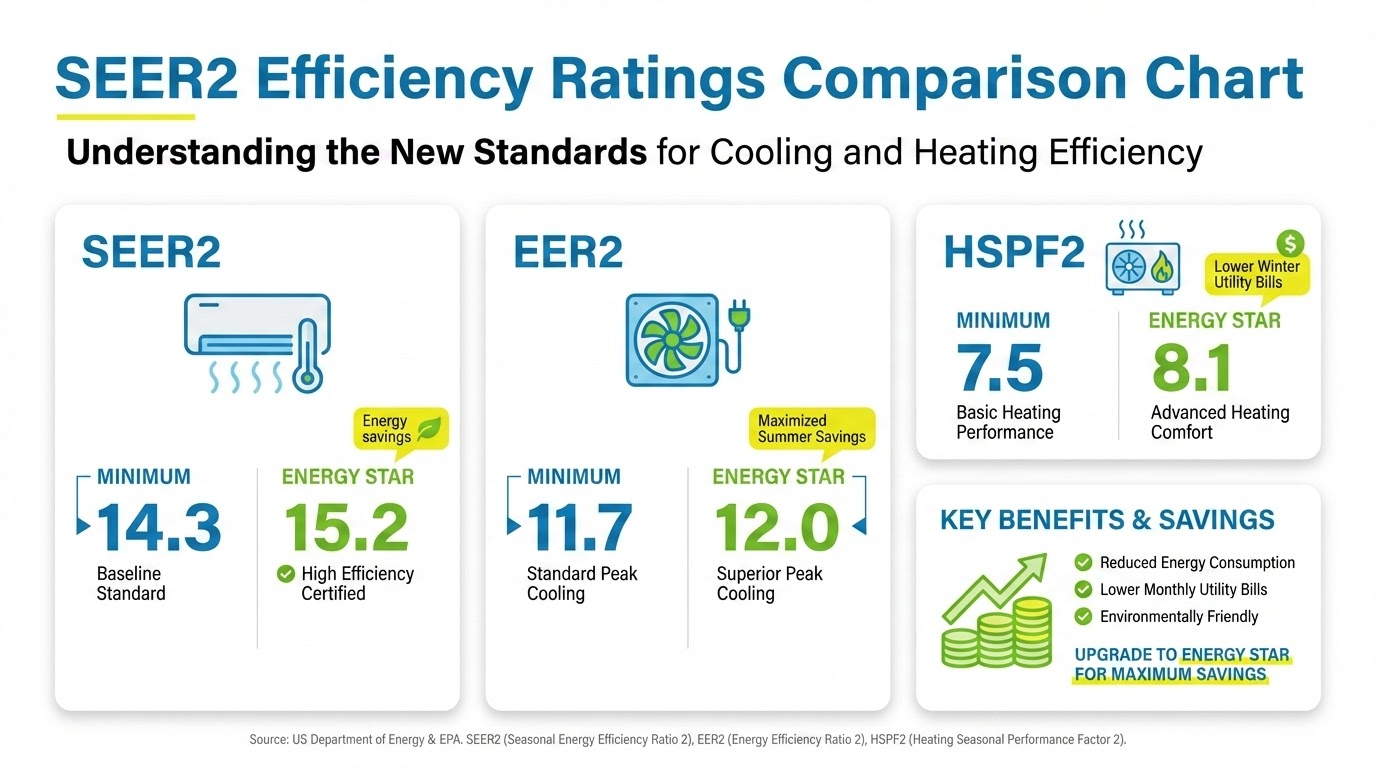
Efficiency ratings underwent a significant change in 2023 when the Department of Energy transitioned from SEER to SEER2 testing procedures. This shift updated how manufacturers measure and report efficiency to better reflect real-world installation conditions. Understanding these ratings helps you make informed decisions about equipment investments.
SEER2 measures seasonal energy efficiency ratio under the new M1 testing standard, which includes higher external static pressure to simulate typical duct system resistance. EER2 measures efficiency at a specific high-temperature condition. For heat pumps, HSPF2 indicates heating season performance. Higher numbers mean greater efficiency and lower operating costs over the equipment lifespan.
| Rating Type | What It Measures | DOE Minimum (South) | ENERGY STAR Threshold |
|---|---|---|---|
| SEER2 | Seasonal cooling efficiency | 14.3 (split systems) | 15.2 or higher |
| EER2 | High-temperature cooling efficiency | 11.7 (split systems) | 12.0 or higher |
| HSPF2 | Heating season efficiency (heat pumps) | 7.5 | 8.1 or higher |
According to ENERGY STAR criteria, equipment earning their certification exceeds federal minimums by a meaningful margin. For Houston’s climate with its extended cooling season, higher SEER2 ratings typically deliver faster payback through energy savings. However, efficiency gains only materialize when systems are properly sized and installed with well-designed ductwork. Investing in premium efficiency equipment while neglecting load calculations or duct design wastes money on potential that never gets realized.
Get your HVAC system designed right the first time with proper load calculations and equipment matching.
Or call us: (832) 737-8500
How Does Construction Activity Affect Indoor Air Quality Before Move-In?
New construction sites generate substantial amounts of dust, debris, and airborne particles. Drywall sanding releases fine gypite dust. Wood cutting produces sawdust. Paint and adhesives emit volatile organic compounds. Without proper precautions, these contaminants can enter HVAC systems and compromise indoor air quality before you even move in.
Protecting Your Investment: Construction Air Quality on Site
Proactive measures during the building process prevent contamination problems. The EPA recommends sealing supply and return registers during dusty work phases to prevent debris from entering ductwork. Sealing duct seams and joints during installation reduces both contaminant entry and air leakage that affects system performance.
Construction air quality management also involves protecting equipment until final installation phases. Outdoor units should remain covered until commissioning. Indoor air handlers benefit from temporary filtration during finishing work. These precautions require coordination between HVAC contractors and general contractors but pay dividends in cleaner systems at move-in.
Post-Construction Considerations: When to Clean Ducts
A common question among new homeowners involves whether duct cleaning is necessary after construction. The answer depends on how well protective measures were implemented during building. According to EPA guidance, routine duct cleaning is generally unnecessary unless specific conditions exist.
Circumstances that may warrant cleaning include visible mold growth inside ducts or on HVAC components, evidence of rodent or insect infestation, or substantial visible debris accumulating in ducts and being released into living spaces. If construction proceeded with registers unsealed during dusty phases, inspection may reveal debris that justifies cleaning. However, cleaning should address the contamination source rather than serving as routine maintenance.
“Stacy’s team was awesome fast and professional! They explained everything to me before they did anything. Very fair pricing. I will definitely use them again.”
Which Permits and Inspections Does Houston Require for New HVAC?
New construction HVAC installations in Houston fall under municipal permitting and inspection requirements. Understanding these regulations prevents delays and ensures your system meets code requirements that protect your investment.
Navigating Local Regulations
The City of Houston requires mechanical permits for new residential air conditioning installations and duct system work. According to the Houston Permitting Center, mechanical inspections verify that installations comply with adopted codes. HVAC alterations and new installations require permits and may necessitate plan review depending on project scope.
Timing matters for permit applications and inspections. Mechanical rough-in inspections typically occur after ductwork installation but before walls close. Final mechanical inspections happen after equipment installation and startup. Coordinating these inspections with construction schedules prevents costly delays. For homeowners undertaking additions or expansions that involve HVAC modifications, staying compliant remains equally important.
The Importance of a Licensed Contractor
Texas law requires air conditioning and refrigeration work to be performed by or under the supervision of a licensed contractor. The Texas Department of Licensing and Regulation establishes requirements including demonstrated experience, insurance coverage, and adherence to professional standards.
Working with a properly licensed contractor protects homeowners in several ways. Licensed contractors carry insurance that covers workmanship issues and potential damage. They understand current code requirements and inspection procedures. Their work typically qualifies for manufacturer warranty coverage that unlicensed installations may void.
Houston building permits can take 2-4 weeks for approval. Plan your HVAC design early to avoid construction delays.
What Happens During HVAC Commissioning and Why Should You Insist On It?
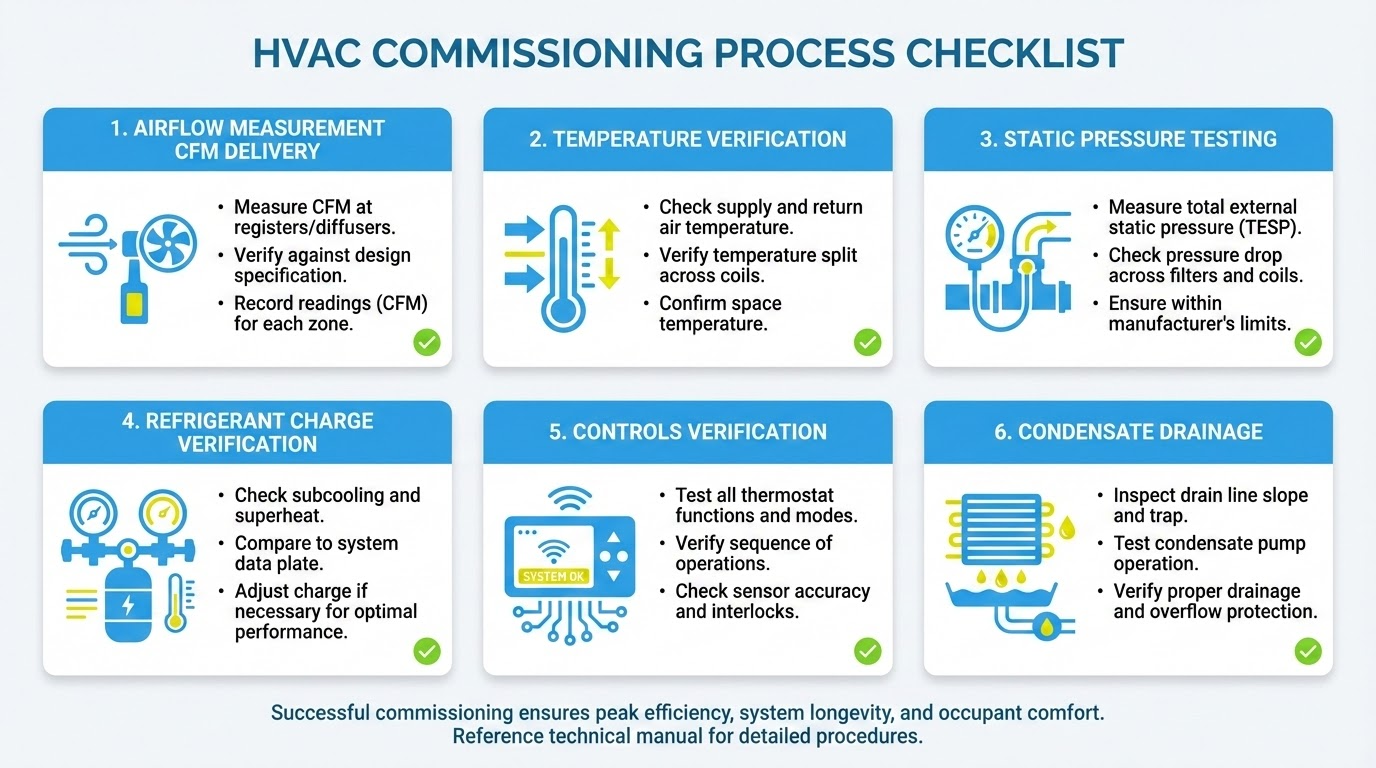
Commissioning represents the quality assurance phase that verifies your new HVAC system performs according to design specifications. This process goes beyond simple equipment startup to systematically test and document system operation.
ASHRAE Guideline 1.1-2025 establishes the framework for applying commissioning processes to new HVAC systems. This guideline addresses commissioning through all project phases from pre-design through occupancy.
| Commissioning Activity | What Gets Verified | Why It Matters |
|---|---|---|
| Airflow measurement | CFM delivery to each room | Confirms design airflows reach intended spaces |
| Temperature verification | Supply air and room temperatures | Validates cooling/heating capacity delivery |
| Static pressure testing | System pressure drops | Identifies duct restrictions or leakage |
| Refrigerant charge verification | Superheat and subcooling | Ensures optimal efficiency and capacity |
| Controls verification | Thermostat and sensor operation | Confirms proper system response to demands |
| Condensate drainage | Drain line flow and trap function | Prevents water damage and microbial growth |
New construction systems that skip commissioning often develop problems that only become apparent after occupancy. Rooms that never reach comfortable temperatures, humidity levels that remain stubbornly high, or equipment that cycles excessively may all trace back to installation or configuration issues that commissioning would have caught. Insisting on documented commissioning provides baseline performance data and evidence that your system was properly set up from the start.
Flat Rates | No Hidden Fees | Same-Day Service Available
Common Mistakes That Undermine New Construction HVAC Performance
Even with quality equipment and professional installation, certain errors repeatedly compromise new home HVAC systems. Recognizing these pitfalls helps homeowners ask better questions and advocate for proper practices during their construction projects.
Engaging HVAC design too late in the construction process ranks among the most expensive mistakes. When duct routes get determined by what spaces remain after framing rather than by optimal airflow design, compromises become necessary. Equipment locations chosen for convenience rather than performance create service access problems and noise issues. Early HVAC involvement during architectural planning prevents these conflicts.
Inadequate return air design causes problems in many new homes. Builders sometimes minimize returns to save cost, leaving bedrooms with supply registers but no return path. When doors close, these rooms pressurize and resist conditioned air delivery. Proper return air design ensures balanced airflow whether doors are open or closed.
Duct leakage testing often gets overlooked despite its significant impact on system performance. Leaky ducts in unconditioned attic spaces waste cooled air before it reaches living areas. In Houston’s hot attics, even moderate duct leakage dramatically increases cooling loads and energy consumption. Specifying duct leakage testing and maximum leakage rates protects your investment in efficient equipment.
How Does Houston’s Climate Influence New Construction HVAC Decisions?
Houston presents specific challenges that influence optimal HVAC system design. High humidity throughout much of the year requires systems with strong latent cooling capability. Extended cooling seasons make efficiency investments more valuable than in milder climates. Occasional heating demands, while modest compared to northern regions, still require consideration.
Latent cooling performance deserves particular attention for new home HVAC in Houston. Systems must remove moisture effectively to maintain comfort and prevent mold growth. Oversized equipment that satisfies thermostat calls quickly without running long enough to dehumidify creates uncomfortable conditions despite adequate temperature control. Proper sizing and equipment selection address this challenge.
Variable-speed and multi-stage equipment offer advantages in Houston’s climate. These systems can run at reduced capacity during moderate conditions, extending run times and improving dehumidification. They also reduce temperature swings and operate more quietly than single-stage alternatives. While premium equipment costs more initially, Houston’s long cooling season allows efficiency savings to accumulate over the system lifespan.
“Very responsive and professional. They got me on their schedule day after I called. The technicians were knowledgeable and took time to explain everything.”
What Questions Should You Ask Before Signing an HVAC Contract?
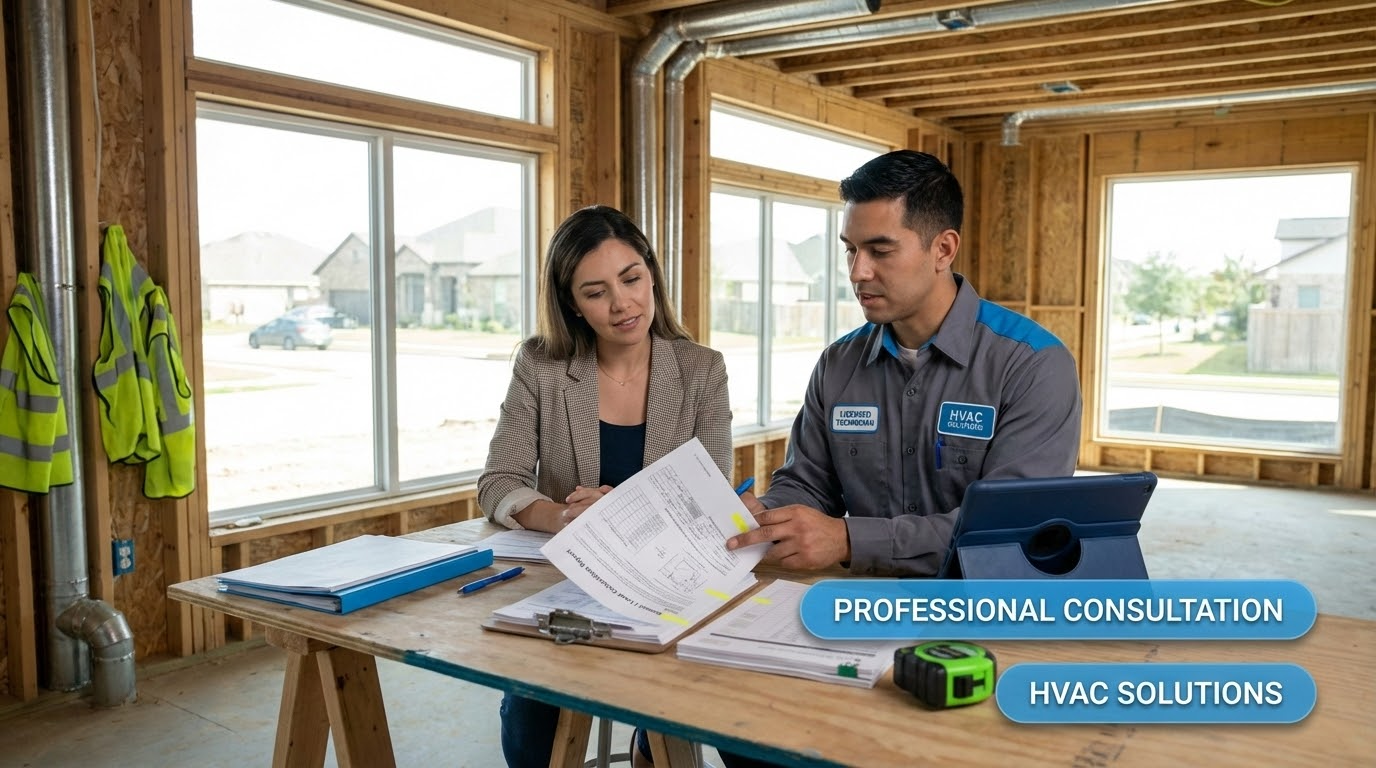
Informed homeowners get better results from their new construction HVAC projects. Asking specific questions helps you evaluate contractor qualifications and compare proposals meaningfully.
Request documentation of load calculations. Contractors who perform Manual J calculations should provide reports showing inputs and results. If a contractor offers to size your system based on square footage or experience alone, consider whether their approach will deliver the comfort you expect.
Ask about duct design methodology. Understanding how duct sizes and layouts were determined reveals whether engineering principles or rules of thumb guided the design. Manual D calculations produce documented airflow requirements for each room.
Inquire about commissioning procedures. What testing will occur at startup? Will you receive documentation of airflow measurements, refrigerant charge verification, and controls testing? Commissioning documentation provides valuable reference information for future service needs.
Clarify warranty coverage and service commitments. Understand what equipment warranties cover, how installation workmanship is warranted, and what ongoing service relationships the contractor offers. New HVAC systems require periodic maintenance to maintain efficiency and warranty coverage.
Frequently Asked Questions
+
+
+
+
+
+
Your new Houston home deserves HVAC systems designed and installed to deliver comfort, efficiency, and reliable performance from day one.
Flat Rates | No Hidden Fees | Same-Day Service Available
Clean Air Houston Pro brings technical expertise in load calculations, equipment selection, and duct design that ensures your system matches your home’s specific requirements. The team coordinates with builders and other trades to integrate HVAC work smoothly into construction schedules while maintaining quality standards.
Construction air quality protection, proper commissioning, and attention to Houston’s climate challenges distinguish professional installations from basic equipment placement. When your family moves in, you should experience consistent temperatures throughout your home, controlled humidity, and energy bills that reflect efficient operation rather than design compromises.
Are you planning a new construction project in the Houston area and want HVAC systems that perform as well as they should? Contact Clean Air Houston Pro to discuss your project requirements and learn how professional design and installation protect your investment. Reach out through the contact page to schedule a consultation and take the first step toward HVAC systems that deliver the comfort your new home deserves.

